
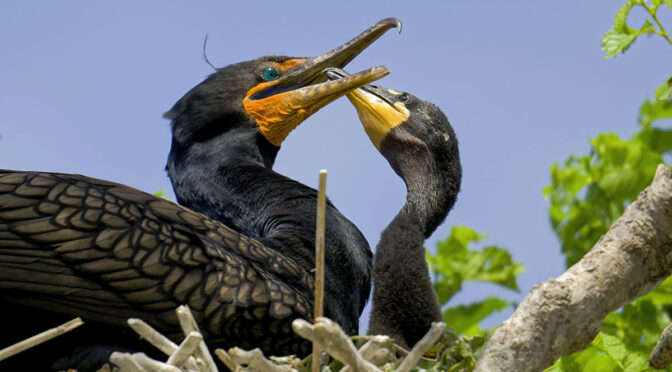
This article features some images of a cormorant with chicks captured handheld along Eastport Drive in Hamilton Ontario. This was one of the stops I made during a photographic scouting mission last week.
NOTE: Click on images to enlarge. To view this article in a range of other languages click on the Canadian flag in the upper right corner.
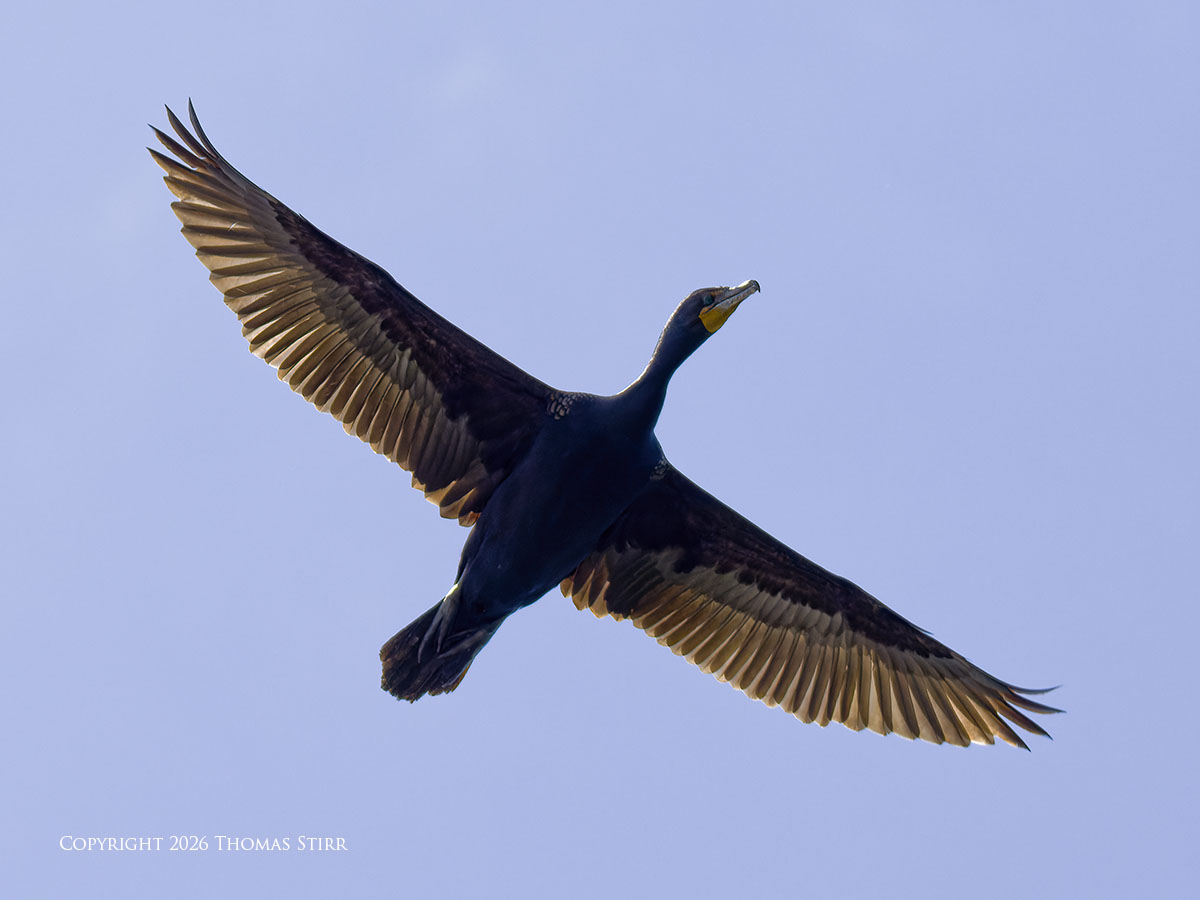
There is a cormorant nesting area that is directly adjacent to Eastport Drive in the Pier 27 area. This location is well known to area photographers as it is a good spot to practice capturing cormorants in flight. One does need to be careful in this location as Eastport Drive is a very busy four lane industrial road. For safety it is best to park one’s car on the eastern shoulder of the road (i.e. on the Lake Ontario side of the road).
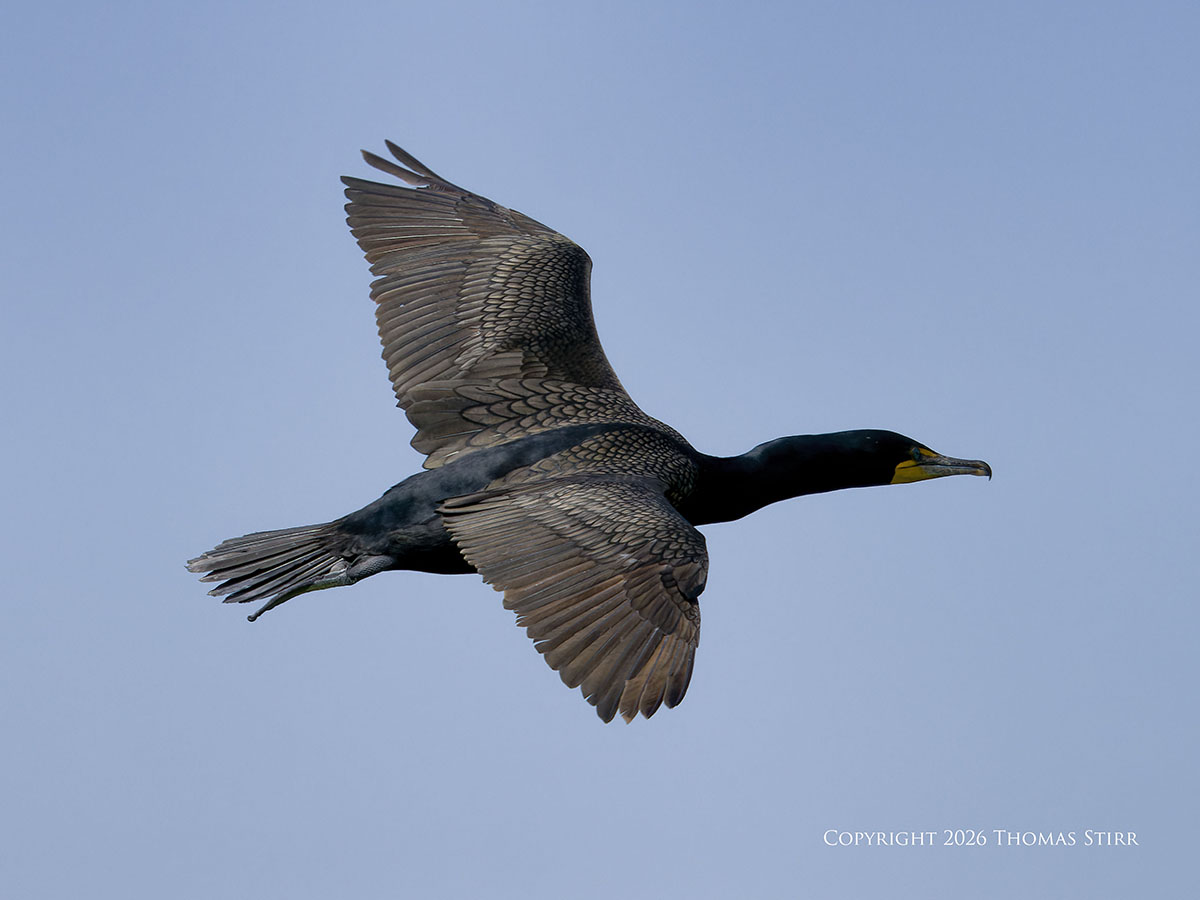
In order to get the best light to highlight the feathers of cormorants in flight it is recommended to visit this area in the morning. One of my favourite cormorant in-flight images to capture is when the birds are banking slightly with their backs towards the sun. This reveals some beautiful, intricate feather details on the tops of their wings.
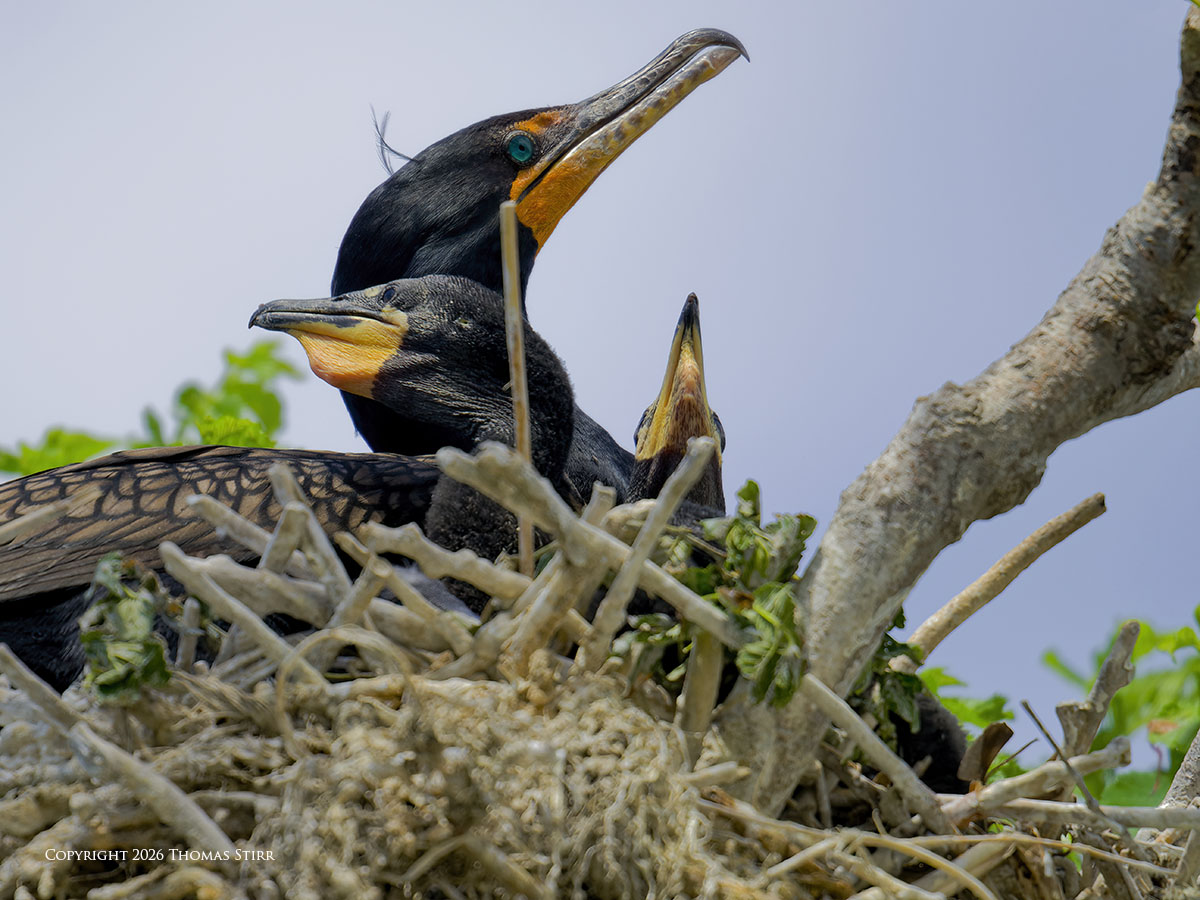
I took some time to examine a number of the occupied nests and discovered that most of them had two or three chicks inside. I was hoping to find a single chick in one of the nests as this would make photographing feeding behaviour a bit easier.
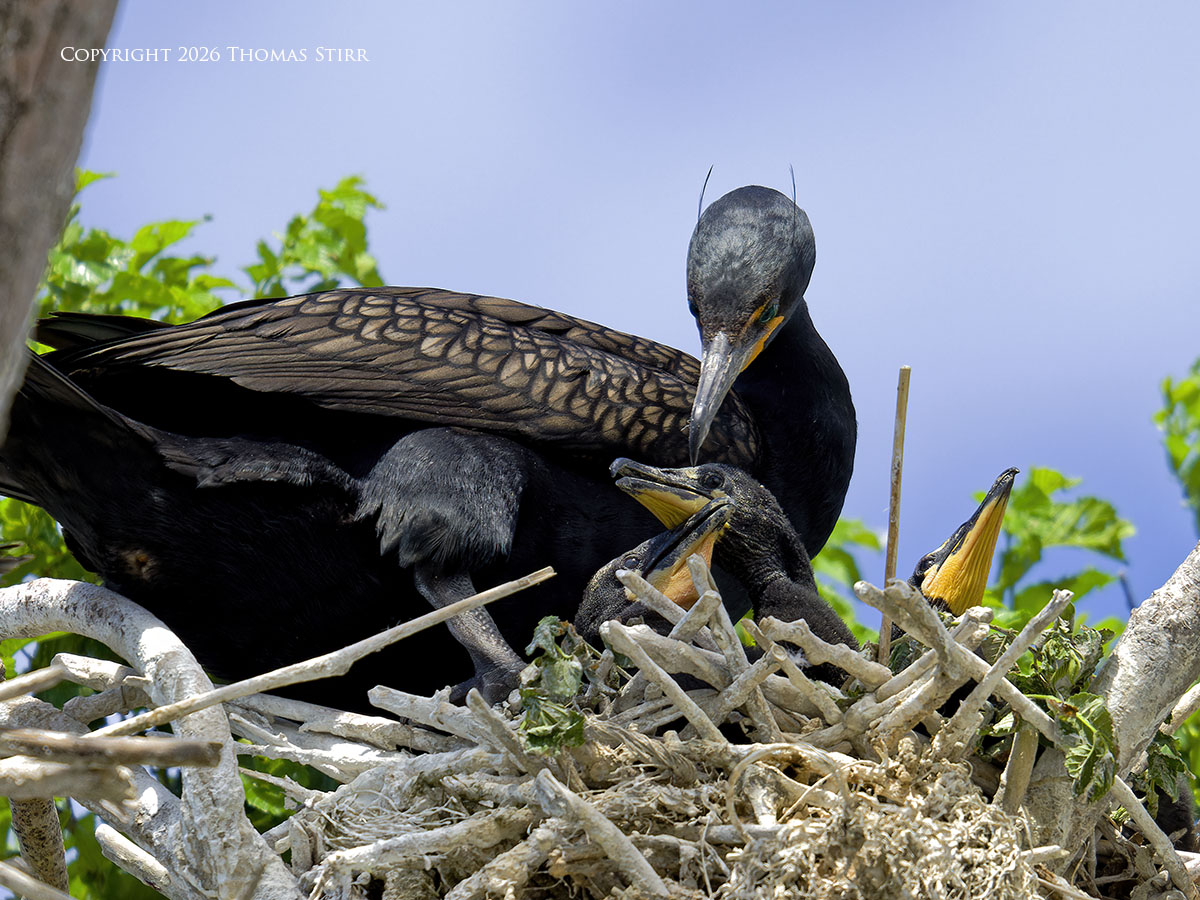
Chicks tend to be very competitive with each other and bedlam can easily break out when food is available. I was able to find one nest with a single chick occupying it.
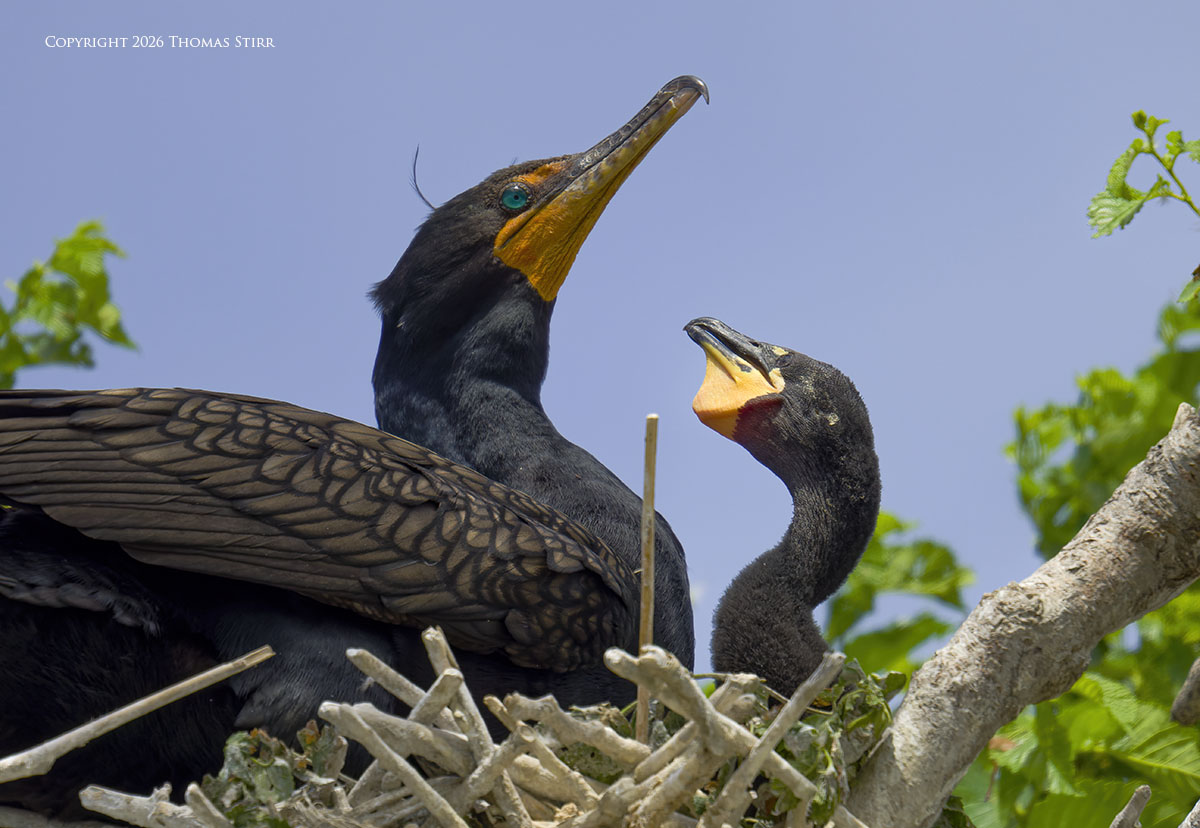
When a chick is anticipating food it tends to stare up at the parent bird rather than looking at its nest or surrounding area.
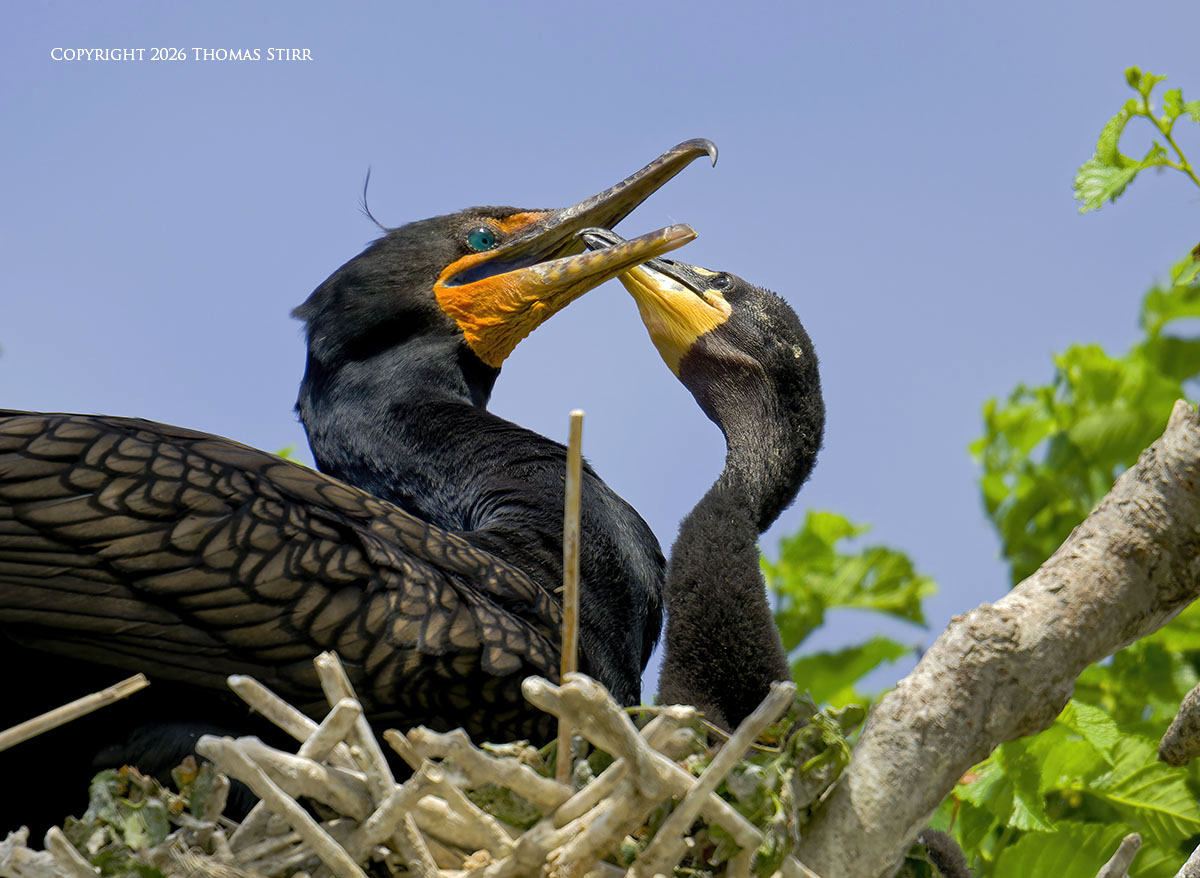
To signal its desire to feed the chick will tap its beak against the adult bird’s beak and try to pry it open.
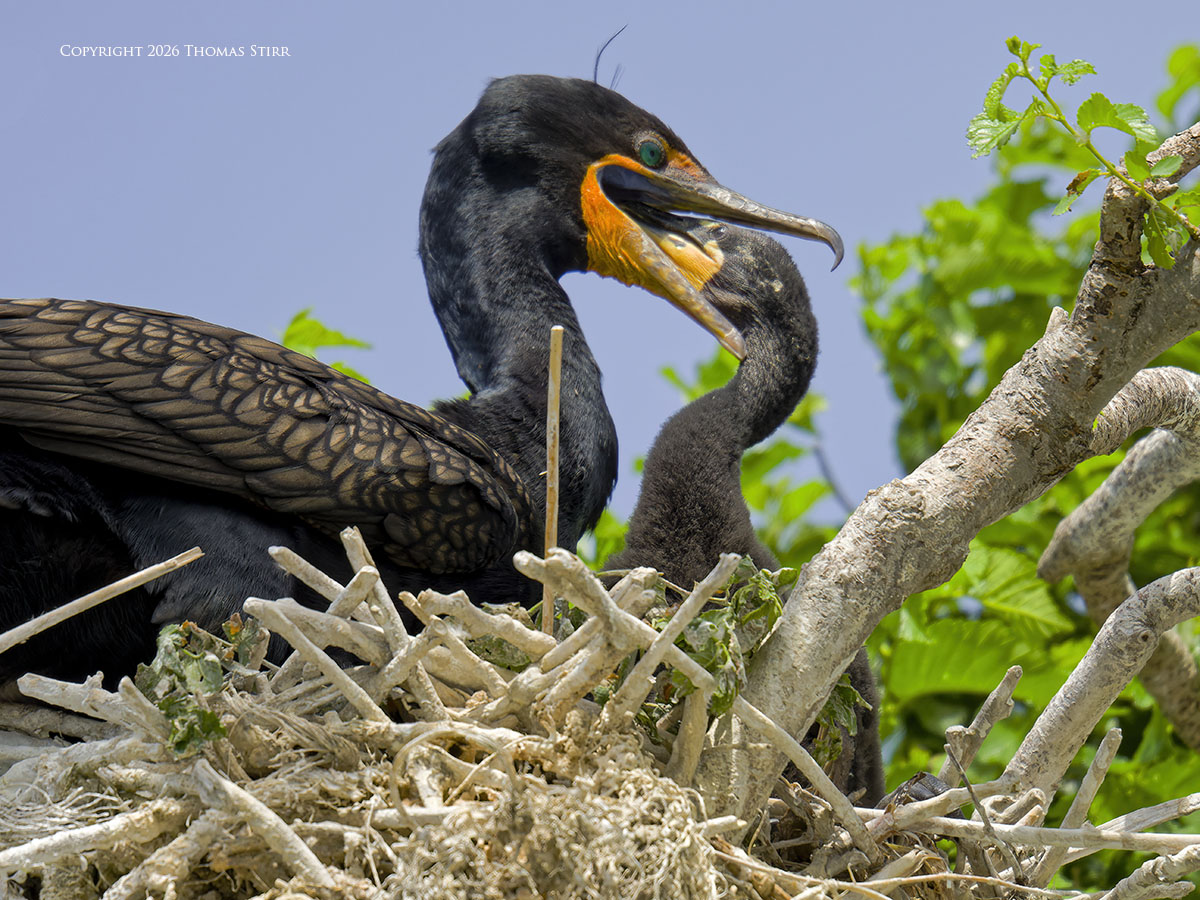
If the adult bird has food available in its stomach it will allow the chick to push its head into its mouth… and further down into its gullet. Once the chick’s head is deep inside the parent’s gullet, the adult bird will regurgitate the fish in its stomach so the chick can consume it.
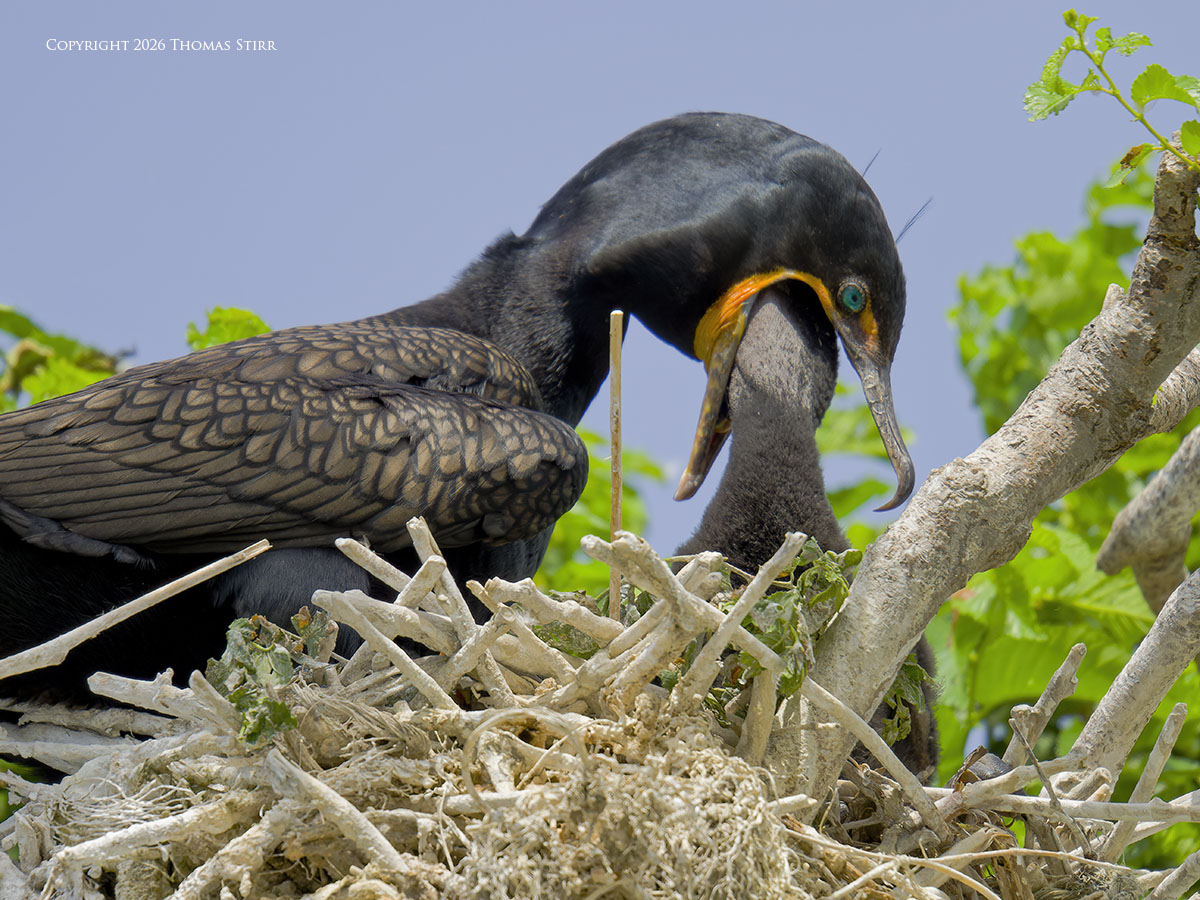
To capture this action I had to physically back up and move away from the nest to get a clear shooting view. Stepping back from the action also allowed me to photograph the birds using a much shallower shooting angle. This created the illusion that I was at about the same height as the birds. I was actually photographing birds in nests that were 1.8 metres (~6 feet) above my head.
One of the significant benefits of using a long telephoto lens like the M.Zuiko 150-600 mm with its equivalent field-of-view of 1200 mm on the long end, is it allows a photographer to easily change their shooting angle. Often this can be done in a way that a photographer can avoid having to crop the resulting image, and thus get more pixels on their subject bird(s).
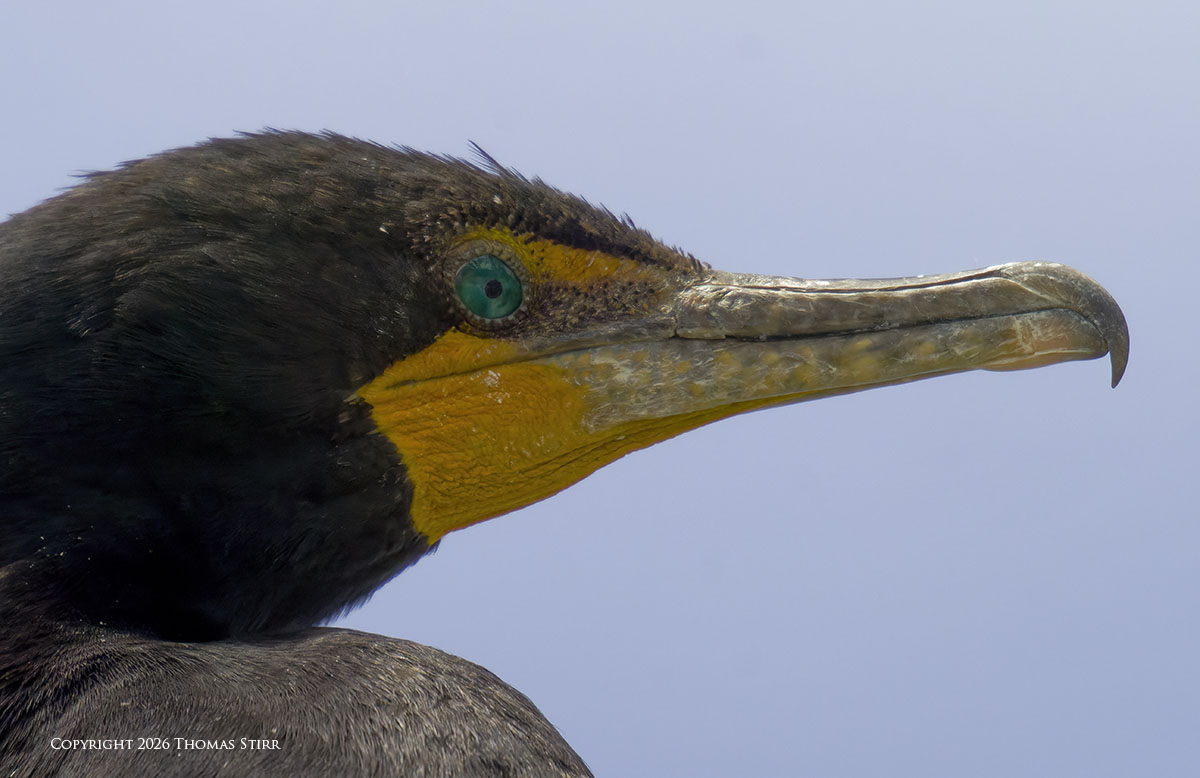
Since I had my M.Zuiko MC-20 teleconverter with me, I thought I’d have some fun using it to help create some cormorant portraits. Adding this teleconverter to my M.Zuiko 150-600 set-up gave me a focal length of 1200 mm, or an equivalent field-of-view of 2400 mm. This is one of my favourite ways to use the MC-20 teleconverter.
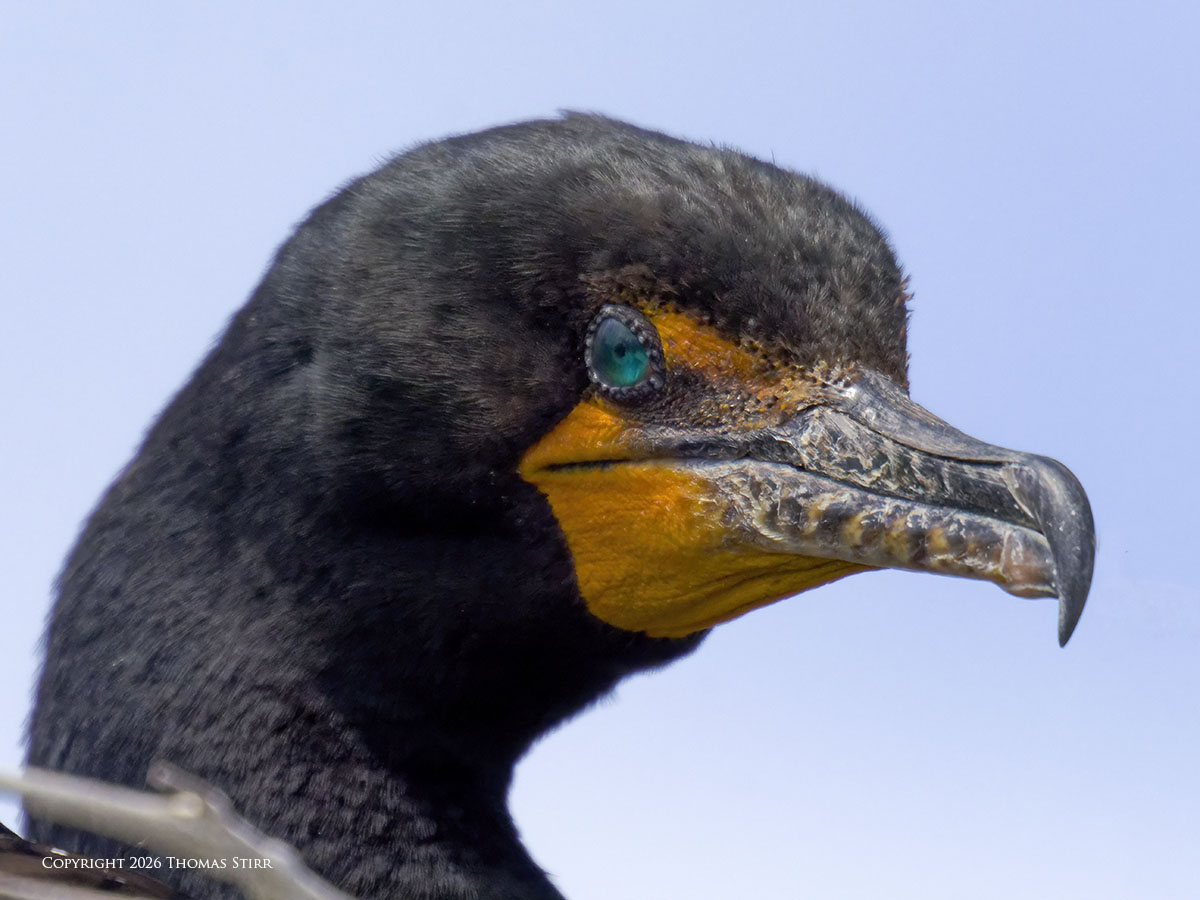
There are some trade-offs of course. These include losing two stops of light, as well as 2 stops of IBIS (in body image stabilization) performance. If you check the EXIF data you’ll see that I increased my shutter speed to 1/1250. My minimum aperture was f/13, and my ISO needed to be increased to ISO-2500 or higher.
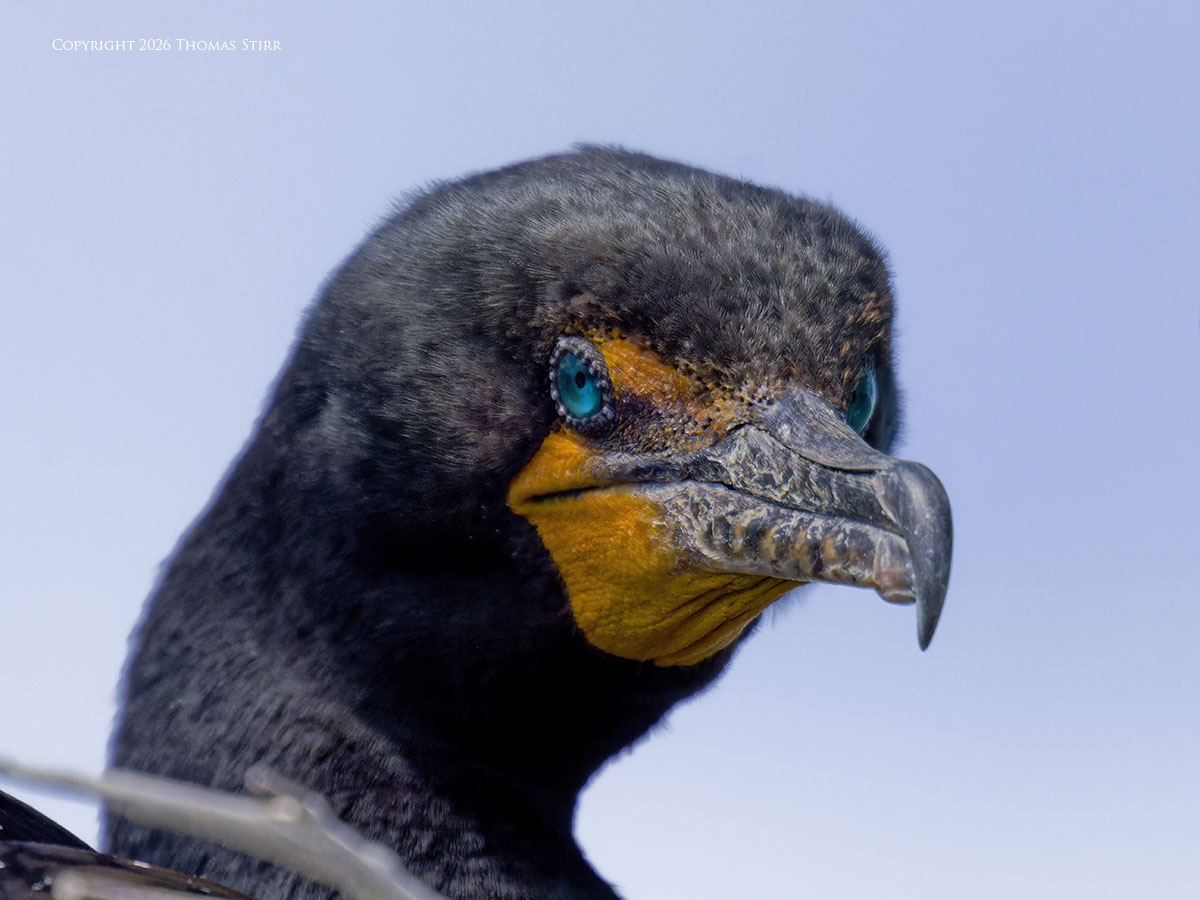
Being able to basically fill my frame with the head and neck of cormorants perched 8.4 to 9.9 metres away was a fun experiment.
During the late spring through early fall birding season in Southern Ontario, cormorants are a very common bird. So common that many photographers don’t even bother trying to capture any images of them. Mother Nature provides us with all kinds of photographic opportunities throughout the year. Its up to us to decide which ones to leverage.
Technical Note
Photographs were captured handheld using camera gear as noted in the EXIF data. All images were created from RAW files using my standard process in post. This is the 1538 article published on this website since its original inception in 2015.
Copyright
Word of mouth is the best form of endorsement. If you like our website please let your friends and associates know about our work. Linking to this site or to specific articles is allowed with proper acknowledgement. Reproducing articles, or any of the images contained in them, on another website or in any social media posting is a Copyright infringement.
Article and images are Copyright 2026 Thomas Stirr. No use, duplication or adaptation of any kind is allowed without written consent. If you see this article reproduced anywhere else it is an unauthorized and illegal use. Posting comments on offending websites and calling out individuals who steal intellectual property is always appreciated!