
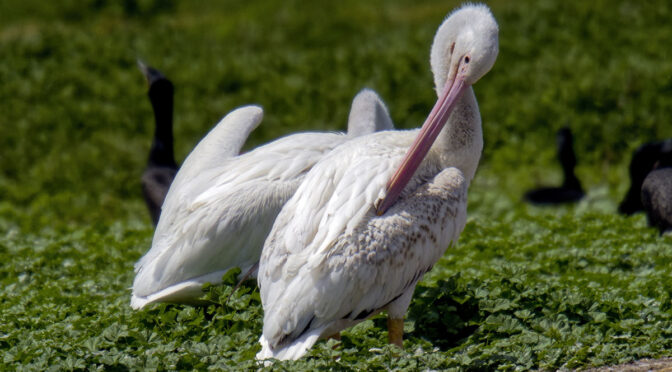
This short article discusses photographing White Pelicans at 2400mm efov handheld at Eastport Drive in Hamilton Ontario. This was an unplanned opportunity as this species of bird is reasonably rare in this part of Canada. In fact, this is the first time I’ve even seen any White Pelicans in this area. All of the images featured in this article are illustrated as full frame captures, without any cropping done to the files.
NOTE: Click on images to enlarge. To read this article in a range of other languages click on the Canadian flag in the upper right corner.
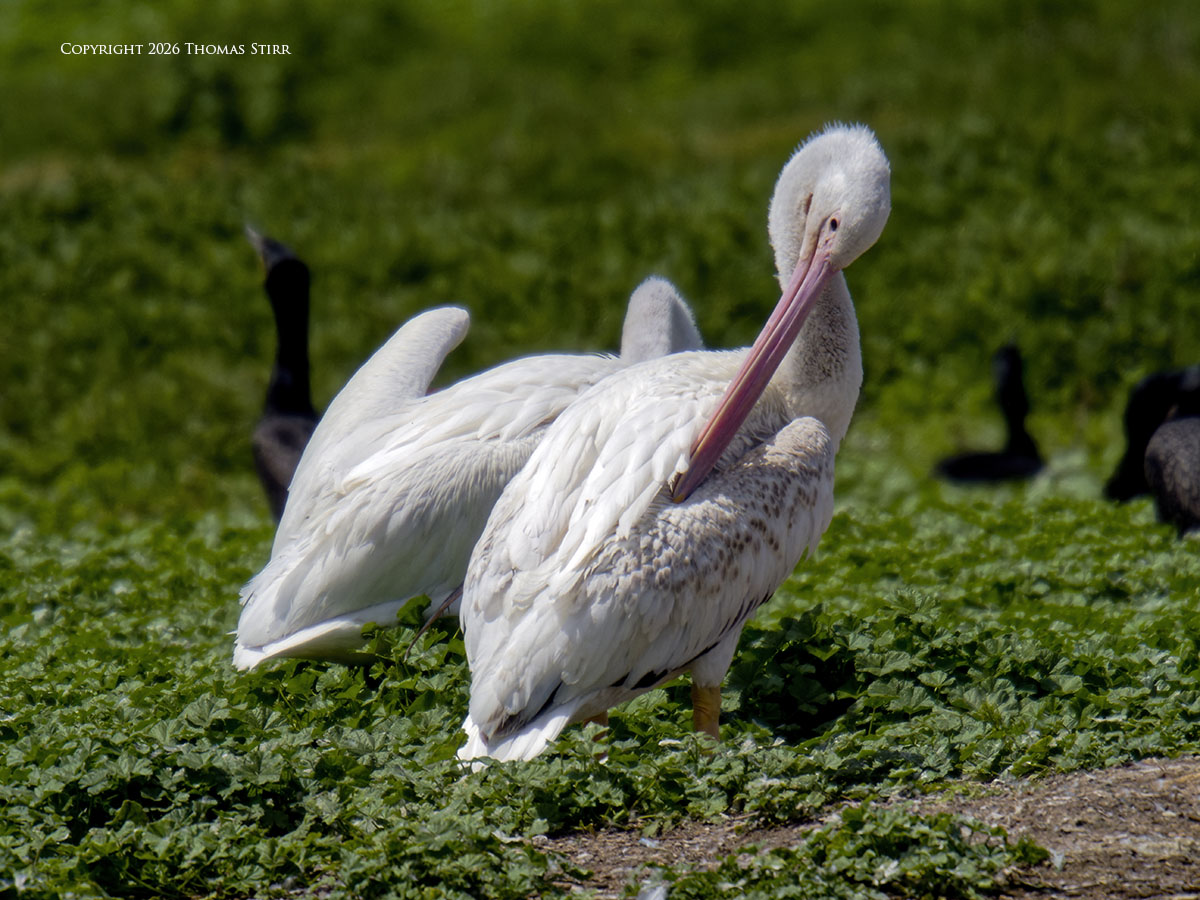
I should mention upfront that these White Pelicans were at least 92.8 metres (~304 feet) away from my shooting position. Being a football field away from the subject birds, I certainly wasn’t expecting great quality photographs. Especially since the images were captured handheld late in the morning under very harsh sunlight. I wasn’t sure I could get anything useable.
While I was out doing some location scouting, I stumbled upon these birds purely by accident. Some other photographers I met at the location told me that their presence in the Hamilton area had been noted in a number of photography blogs.
This news had attracted a number of photographers to visit the area over the past week or two. Since I never read other photography websites I was totally unaware that these White Pelicans were in the area.
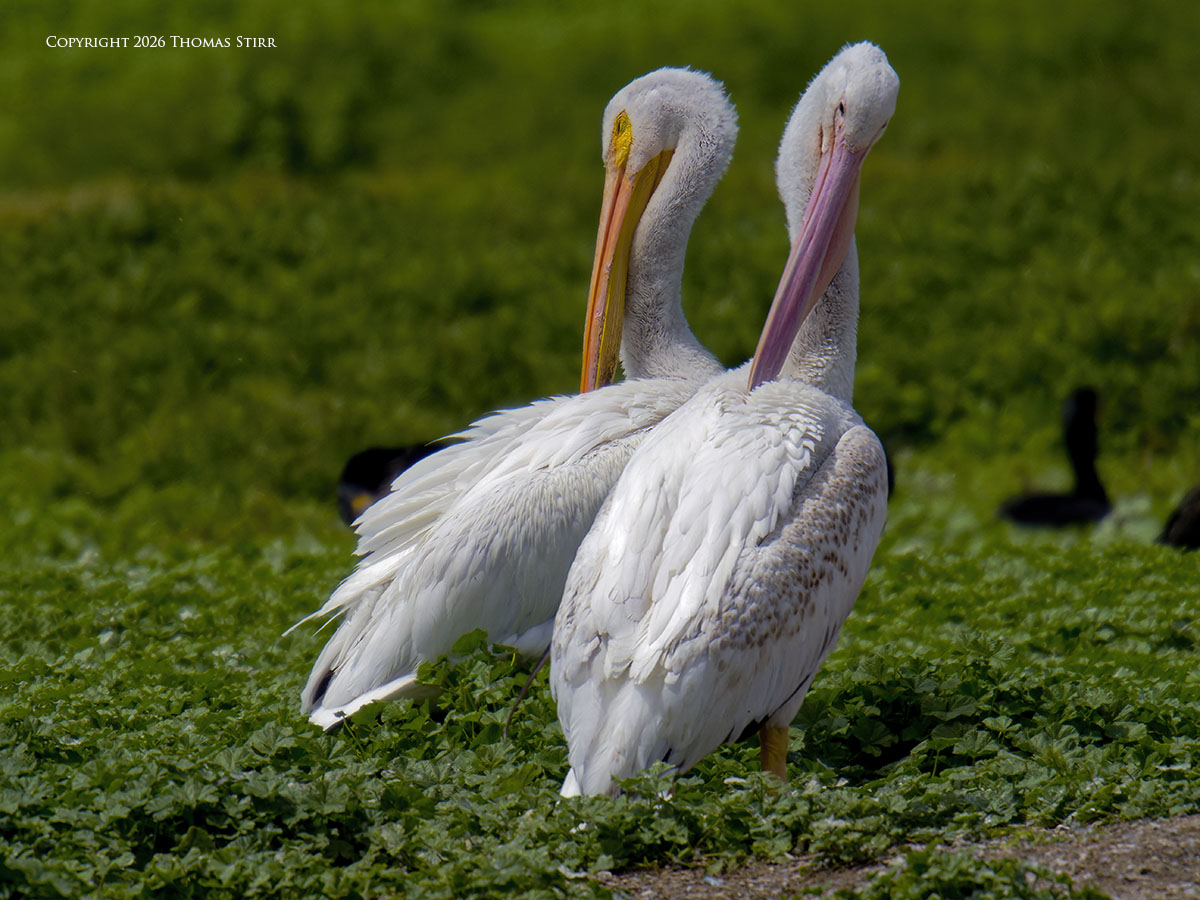
I initially tried to photograph these White Pelicans with my M.Zuiko 150-600 mm f/5-6.3 IS zoom fully extended to 600 mm, or an equivalent field-of-view (efov) of 1200 mm. The sun was quite harsh and I struggled trying to get a decent exposure on these large, white birds.
I was getting some warning blinks in my viewfinder, and my images when viewed on the back screen of my camera, indicated that I was likely clipping the highlights on the backs of the birds. It occurred to me that if I could get the birds much larger in my viewfinder that I may have an increased chance to get a better balanced exposure on them.
So, I went back to my car and added my MC-20 teleconverter to my set-up. This gave me a focal length of 1200 mm or an efov of 2400 mm. It also meant that my minimum available aperture was f/13. Using the MC-20 also has a penalty of 2 stops of IBIS performance with my camera body. To compensate I increased my shutter speed to 1/1250. Given the bright lighting this still allowed me to shoot at no more than ISO-640, which helped preserve some dynamic range.
As you look at the featured images and the EXIF data you’ll see that I dialed in some exposure compensation (i.e. -0.7 EV or -1.0 EV) to help hold onto the highlights on the backs of the White Pelicans.
I typically don’t use teleconverters to capture images of distant birds, but instead usually use them to get in tighter on birds to capture more head and beak details.
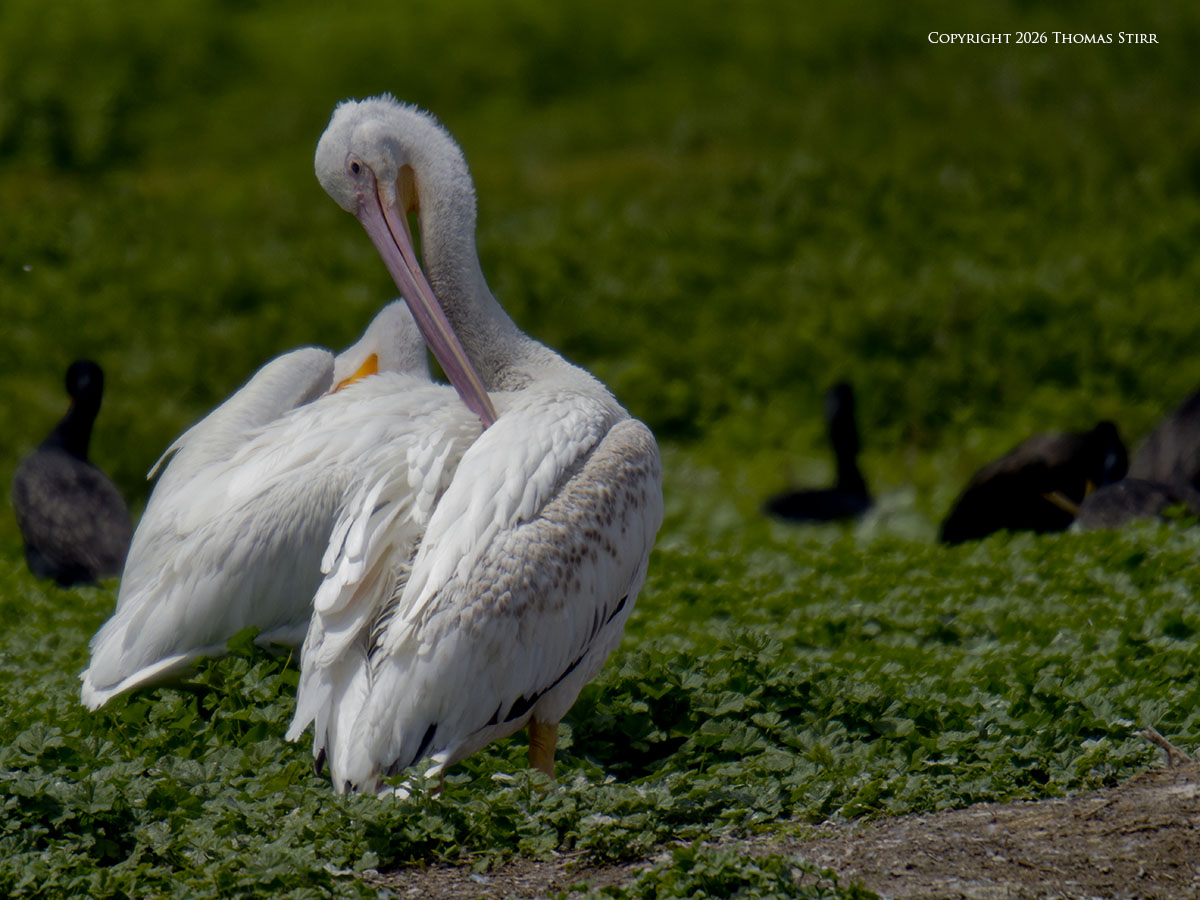
As regular readers know I’ve never claimed to be highly skilled in post production. No doubt other photographers who are more skilled and experienced in post could have done a much better job with these RAW files than I could do.
Given the handheld shooting conditions and subject distance, I was reasonably pleased with the White Pelican images I was able to capture. For all I know, these images may be the only opportunity that I’ll ever get to photograph White Pelicans in my local area.
What I do know is that I was about a football field away from these White Pelicans and did the best I could with the gear I own. The results, while far from technically perfect, were good enough for my purposes for this article. At the end of the day, that’s all we can do… try our best and accept the outcome.
For folks interested in GPS information for this shooting location, Latitude was 43; 17; 5.424, Longitude was 70; 47; 24.972.
Technical Note
Photographs were captured handheld using camera gear as noted in the EXIF data. All images were created from RAW files using my standard process in post. This is the 1537 article published on this website since its original inception in 2015.
Copyright
Word of mouth is the best form of endorsement. If you like our website please let your friends and associates know about our work. Linking to this site or to specific articles is allowed with proper acknowledgement. Reproducing articles, or any of the images contained in them, on another website or in any social media posting is a Copyright infringement.
Article and images are Copyright 2026 Thomas Stirr. No use, duplication or adaptation of any kind is allowed without written consent. If you see this article reproduced anywhere else it is an unauthorized and illegal use. Posting comments on offending websites and calling out individuals who steal intellectual property is always appreciated!