
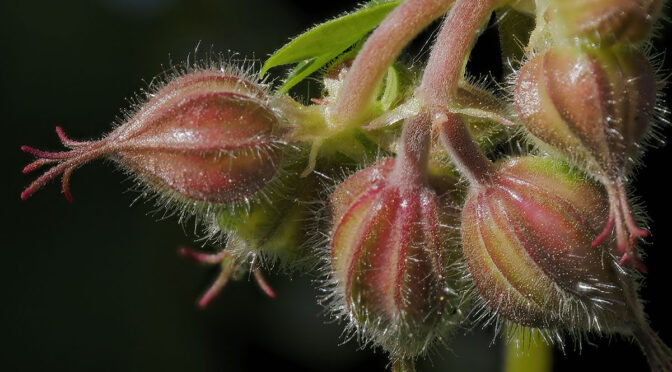
I’ve been continuing to practice handheld focus stacking with the MC-20 teleconverter and M.Zuiko 90 mm f/3.5 PRO IS macro lens. This article features a selection of HHFS (handheld focus stacked) backyard images of some insects and blossoms.
NOTE: Click on images to enlarge.

One of the challenges when trying to photograph insects using handheld focus stacking is choosing subjects that remain stationary long enough for the set of images to be captured. As we can see in the image above, even some minor movements with the back legs of this fly left some motion artifacts behind.

Three P’s come into play with these types of image captures… patience… persistence… and practice. If I can end up with a handful of keeper images… and some learning… from an individual test session, I consider it a worthwhile exercise.
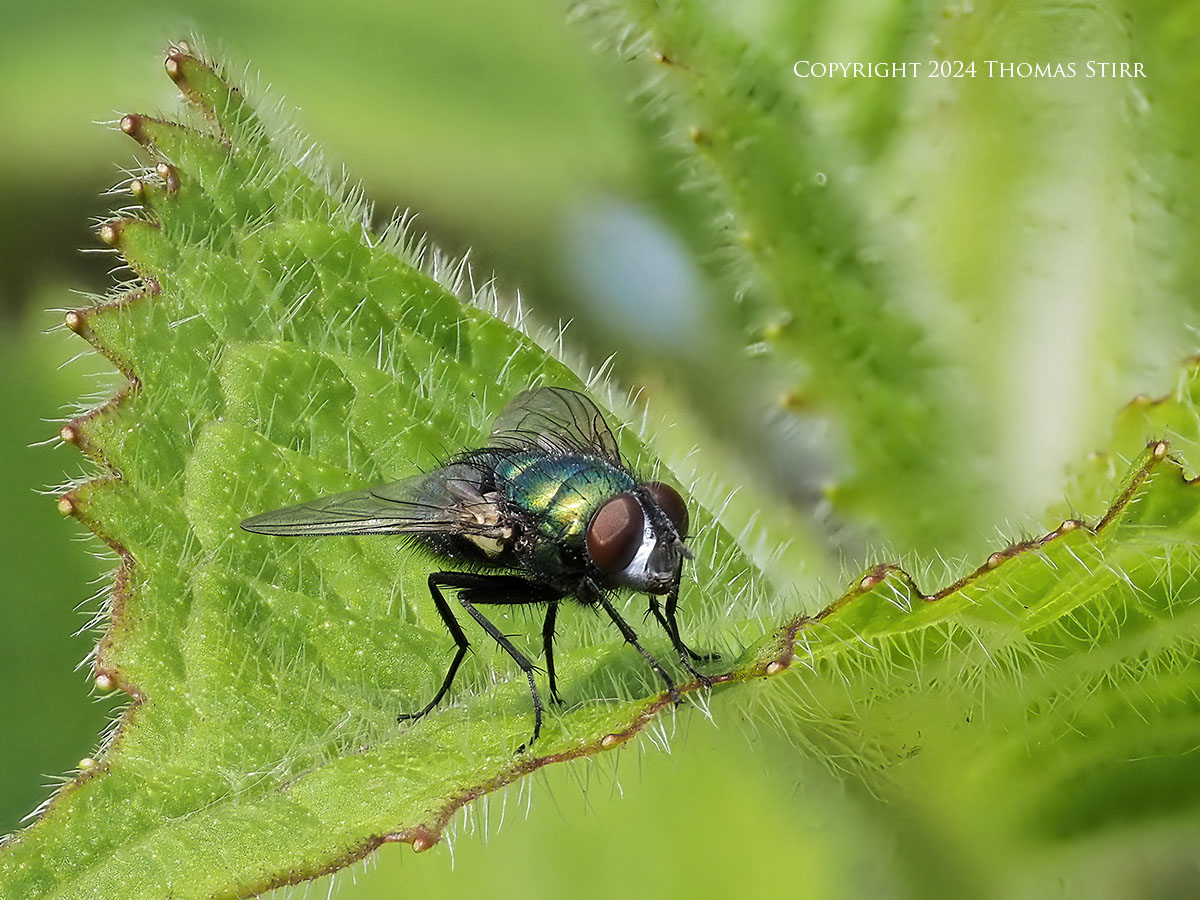
I’ve been spending a lot of time studying the movement patterns of flies and some other insects to help me become more discerning with my choice of subject. Some insects simply do not stay still long enough to make them viable subject candidates for handheld focus stacking technology.
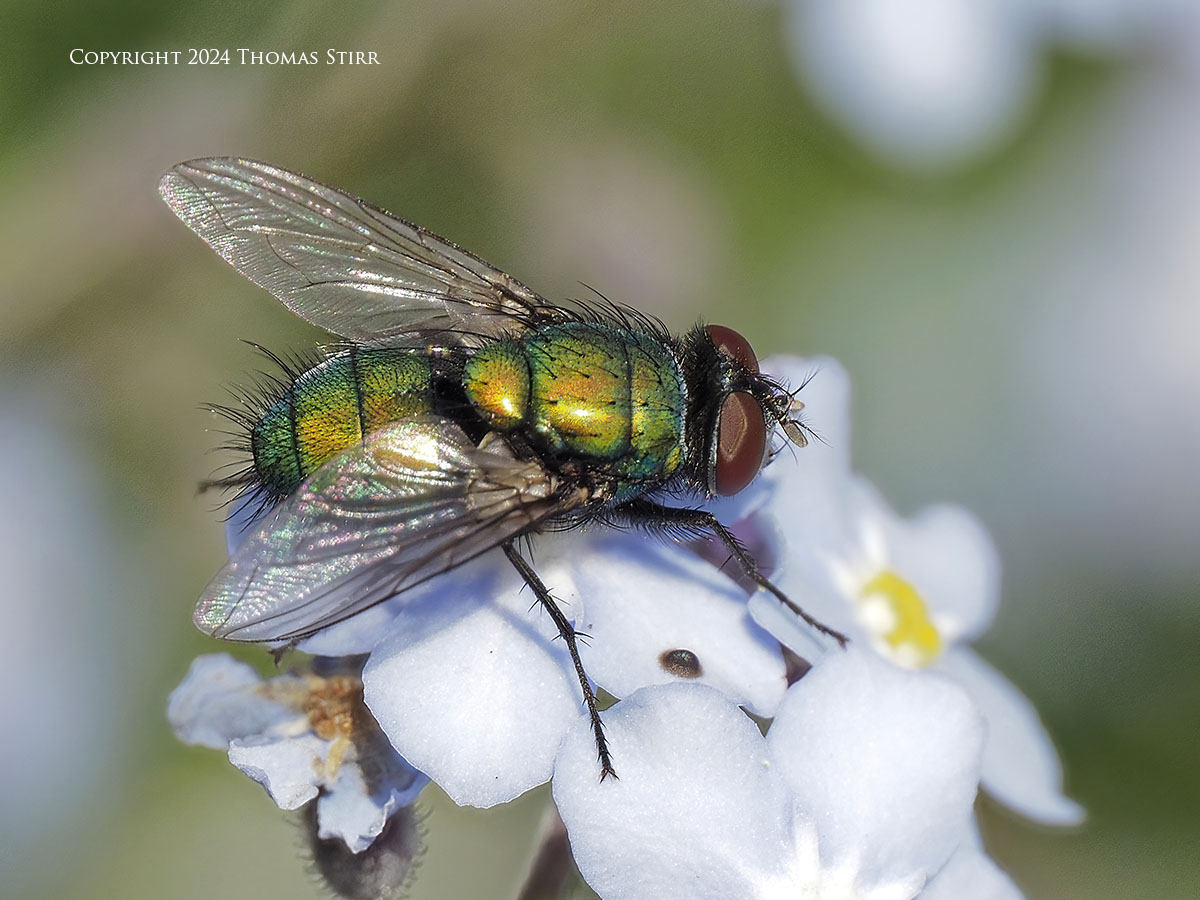
Generally speaking, flying insects that land on leaves, branches and non-flower surfaces tend to be more static than those that land on blossoms. Some subjects do remain still for a few seconds after they’ve initially landed on a flower. If one is quick enough a handheld focus stacked image can be created. Once the insect begins to feed and move around on the blossom there is little chance of success with HHFS technology.

Tiny spiders can make interesting subjects if a photographer has the patience to wait for it to stop at the right spot and shooting angle to yield a useable photograph. The spider above was constantly moving around the top of a small solar light in my garden for well over 5 minutes before it stopped in a good location which allowed me to create a useable image.
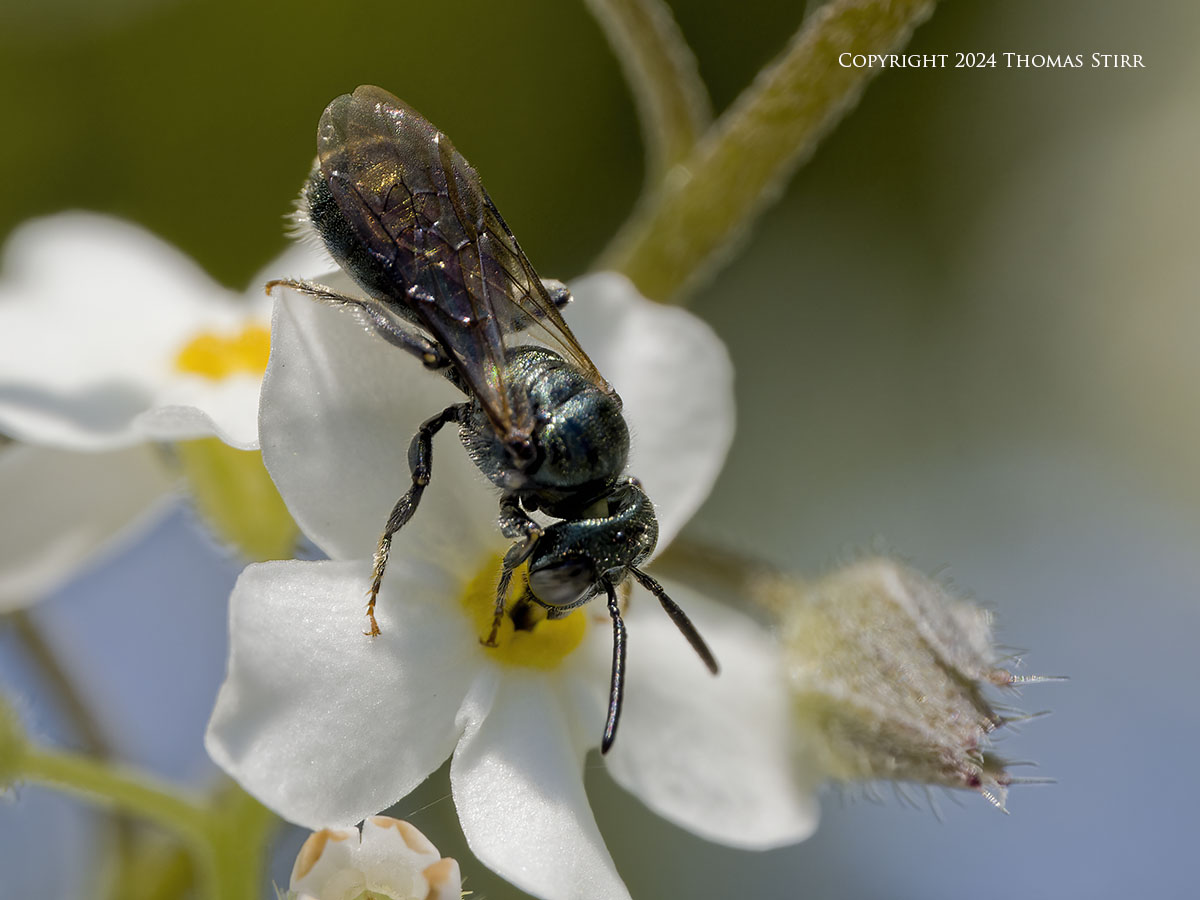
For some skittish subjects the best approach was to quickly get out of the in-camera focus stacking technology, and capture a standard macro photograph.

This became my standard approach once an insect began feeding on a blossom as it was pretty much impossible to capture a good, clean HHFS image.

I have adjusted some of my HHFS technique which has helped improve my success rate. The first was slightly adjusting how I grip my E-M1X camera body.

My left hand is now in a parallel position with my right hand… firmly grasping the body on the left side, rather than supporting/cradling my M.Zuiko 90 mm macro lens from underneath. I’ve found this small adjustment has helped to reduce handheld camera movement. I typically compose all of my macro images from the rear screen of my camera.

I’ve also made a minor adjustment to my in-camera focus stacking settings. My standard settings when using the M.Zuiko 90 mm f/3.5 PRO IS macro lens are now an in-camera focus stack of 12 images, with a focus differential of 5. Rather than the 10 and 4 approach I use with the M.Zuiko 60 mm f/2.8 macro lens.

Every photographer will need to experiment with their gear to determine which settings will work best for them, and their shooting style. These minor tweaks have helped me capture a higher ratio of HHFS keeper images.

As long as I have enough light, I have no hesitation using the MC-20 or MC-14 teleconverters with HHFS technology. My in-field experimentation with the M.Zuiko 90 mm f/3.5 PRO IS macro lens is continuing… including using this lens with the M.Zuiko STF-8 Twin Macro Flash. More on that later…
Technical Note
Photographs were captured handheld with the camera equipment and technology noted in the EXIF data. All images were created from out-of-camera jpegs or RAW files using my standard process in post. This is the 1,387 article published on this website since its original inception in 2015.
Word of mouth is the best form of endorsement. If you like our website please let your friends and associates know about our work. Linking to this site or to specific articles is allowed with proper acknowledgement. Reproducing articles, or any of the images contained in them, on another website or in any social media posting is a Copyright infringement.
Article and images are Copyright 2024 Thomas Stirr. All rights reserved. No use, duplication or adaptation of any kind is allowed without written consent. If you see this article reproduced anywhere else it is an unauthorized and illegal use. Posting comments on offending websites and calling out individuals who steal intellectual property is always appreciated!
Hey Thomas,
Amazing photos! I just tried on my EM1 Mkiii an L bracket that is meant for flash, it has a nice rubber handle and mounted it on the camera for my left hand to hold. What a difference it makes for hand held stacking. Going to try it for sure tomorrow morn. Also put on the 12-100 f4 Pro IS lens and the stability is crazy.
Cheers! Randy
Hi Randy,
Thanks for sharing the use of the L bracket for additional handheld stability… this may be helpful for other readers.
Tom
I made a left hand grip on my L bracket. I hold now as you are now finding more stable.
Hi Brian,
Thanks for sharing your experience with creating additional grip space with your camera and the increased stability that resulted. Over the years the E-M1X has gotten a lot of criticism about its size… without much understanding about the benefits of the design and stability of the body.
Tom