

This short article discusses photographing aquarium fish and provides some basic technique tips that can be utilized for this subject matter. Images featured in this article were captured last week at a public zoo.
NOTE: Click on images to enlarge. To view this article in a range of other languages click on the Canadian flag in the upper right corner.

One of the challenges we have when photographing aquarium fish in public venues is that the light is often quite poor. This can necessitate the use of higher ISO values, and increase the likelihood of noise in our images.
We are also often faced with thick, soiled aquarium glass. It is important that we remain constantly aware of any reflections in the aquarium glass… especially if we are unable to get the front of our lens pressed flat and right up against the glass.
Reflections can change rapidly depending on other visitors to a specific display. The brightness of their clothing. And, the shooting angle of our camera.
If our camera is at an angle to the glass wall of the aquarium we may need to brace the front of our lens with the thumb on our left hand… then use the fingers and palm of our hand to help block side reflections from appearing in our photograph.
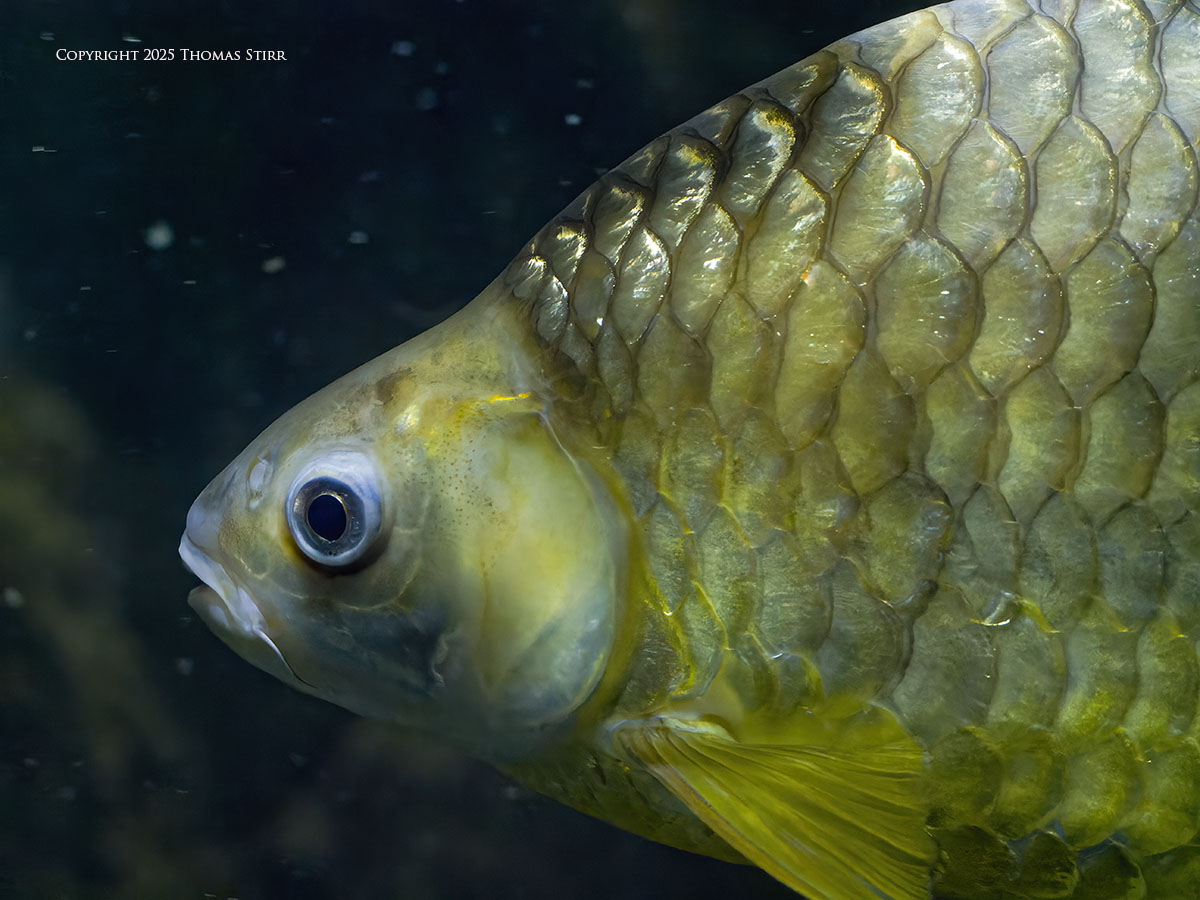
It can be beneficial to choose subject aquarium fish that are far enough away from the glass in their enclosure so we can effectively shoot through the glass without having the soiled surface appear in our images…. but not too far away as to get distortion from the water in the tank. This is often a distance of roughly 1 to 3 metres away. Doing some practice images with your specific gear is suggested.
We need to determine an acceptable ISO value for our aquarium fish images upfront. For my purposes I’m comfortable photographing aquarium fish using ISO values as high as ISO-6400. I know that I can deal with the resulting noise in post. That maximum ISO value, in combination with our aperture setting, will determine our shutter speed.

To get the fastest shutter speed possible given the shooting conditions, I shot my M.Zuiko 150-600 fully retracted to 150 mm (efov 300 mm). This gave me a minimum aperture of f/5.
Using ISO-6400 with an aperture of f/5, meant that the fastest shutter speed I could use was between 1/100 and 1/125 of a second… given the lighting conditions in the aquarium. This would not have been fast enough to completely freeze the motion of a fish as it was swimming through my composition.
In order to reduce the risk of motion blur from the moving subject fish I had to pan with the subject fish, keeping it in the same position in my composition as it was swimming… and I was capturing images.

Given the somewhat slower shutter speed I had to be careful with how much of the fish that I had in my composition. As a fish is swimming it tends to have the most motion in the back half of its body. By concentrating my compositions on the head, gill and front fin of a subject fish I was able to reduce the risk of motion blur caused by the back end of the fish and its tail.
From a stylistic standpoint I often prefer to get in tight to photographic subjects as it creates more details in my images. So, creating full frame captures of mainly just the head of a fish suits my photographic style very well.
Technical Note
Photographs were captured handheld using camera gear as noted in the EXIF data. All images were created from RAW files using my standard process in post. A single, small auto-focus point was used for all of the images in this article. This is the 1,482 article published on this website since its original inception in 2015.
Copyright
Word of mouth is the best form of endorsement. If you like our website please let your friends and associates know about our work. Linking to this site or to specific articles is allowed with proper acknowledgement. Reproducing articles, or any of the images contained in them, on another website or in any social media posting is a Copyright infringement.
Article and images are Copyright 2025 Thomas Stirr. All rights reserved. No use, duplication or adaptation of any kind is allowed without written consent. If you see this article reproduced anywhere else it is an unauthorized and illegal use. Posting comments on offending websites and calling out individuals who steal intellectual property is always appreciated!