
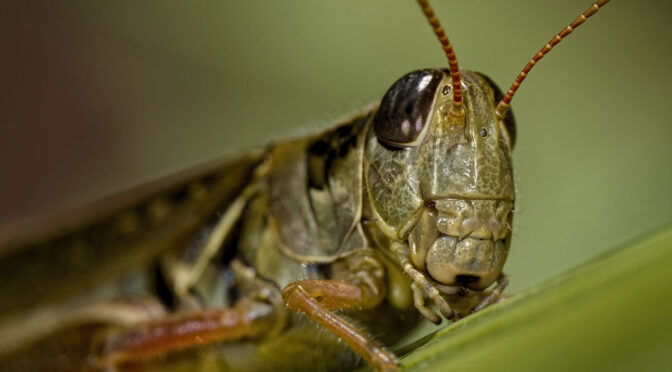
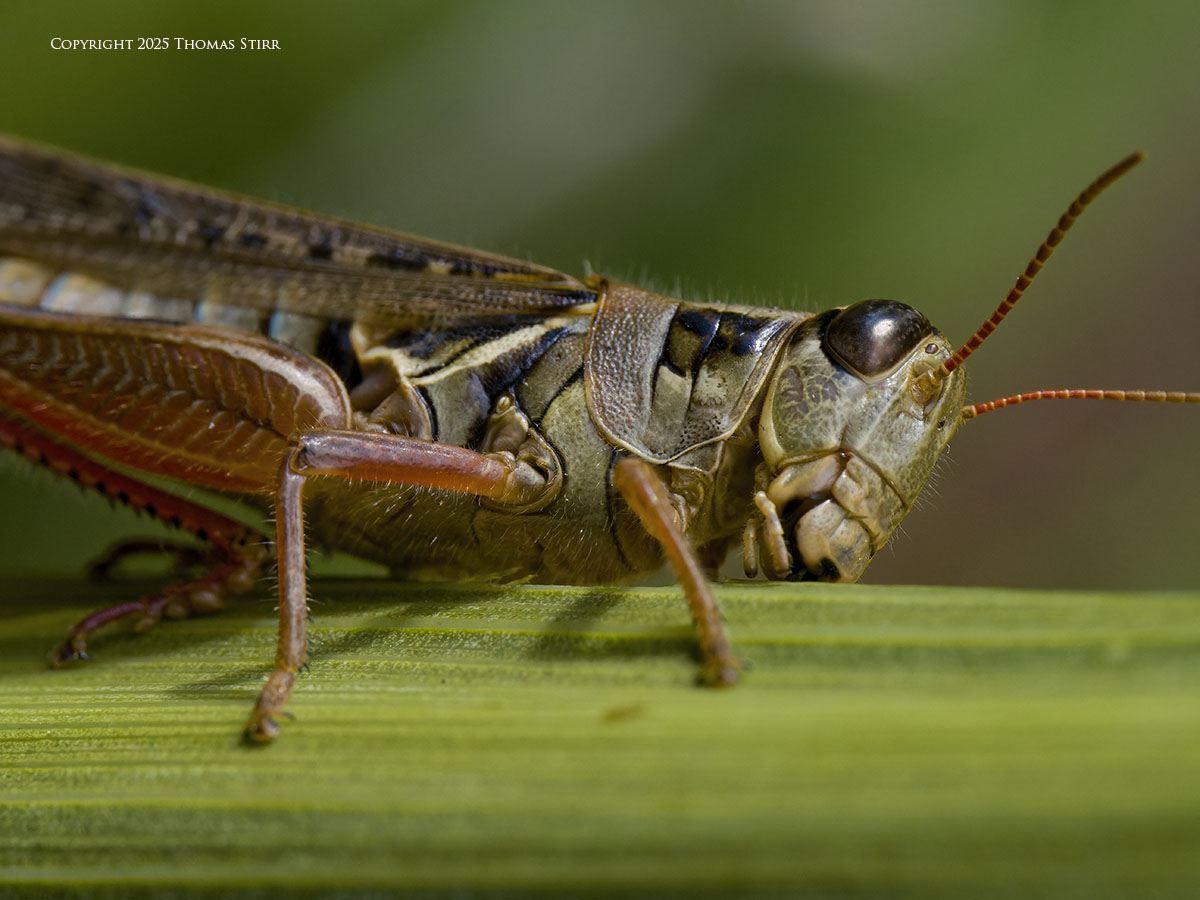
This article features a selection of handheld grasshopper macro images captured with the M.Zuiko 90 mm macro IS PRO lens. I used the M.Zuiko MC-20 teleconverter for all of the photographs in this article. Most of the images were captured using handheld in-camera focus stacking technology. A few photographs at the end of the article were captured using the M.Zuiko STF-8 Twin Macro Flash.
NOTE: Click on images to enlarge. To view this article in a range of other languages click on the Canadian flag in the upper right hand corner.

I initially grabbed my camera gear to capture a handheld in-camera focus stacked macro image of a small spider that had spun a web adjacent to the front door of my home. That prompted me to look around for some other potential macro subjects.

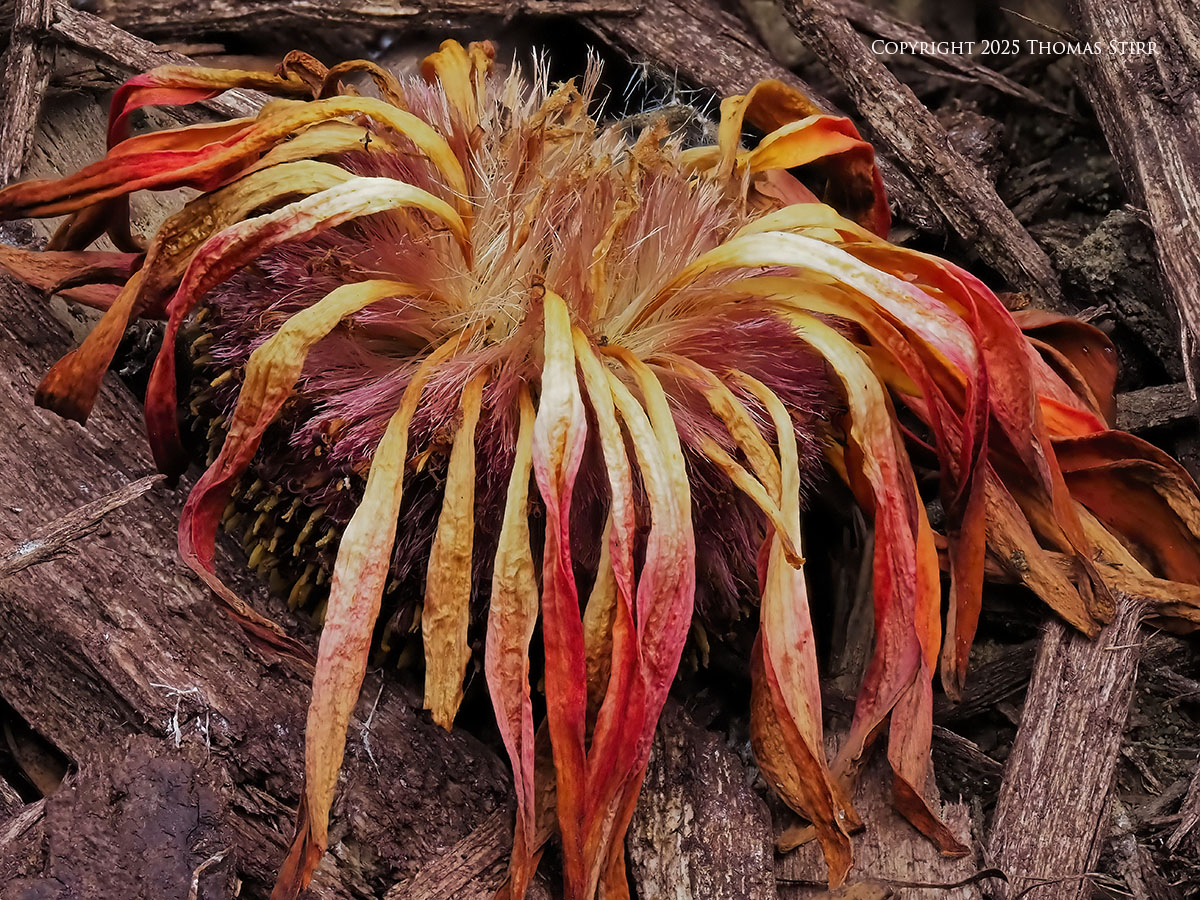
After photographing a couple of flowers that were past their prime, I spotted a grasshopper perched on a leaf.

Having the M.Zuiko MC-20 teleconverter fitted with my 90 mm macro lens came in very handy as could frame my image from a distance. Grasshoppers can be skittish if they are approached too quickly, or if a photographer moves in too closely.

I moved in a bit closer and was able to capture the handheld in-camera focus stacked image above. Pressing my luck, I tried to move in even tighter. This caused the grasshopper to leap to another plant in the garden.

After carefully examining a number of other plants in my garden I was able to find the grasshopper again. It was somewhat buried in some foliage, so I had to gently thread my camera gear through a number of stems and branches to capture the above photograph.

I appreciate that many photographers use a diffuser with a flash for the majority of their macro photography. Since I often photograph subjects that are buried or semi-buried in foliage I find the M.Zuiko STF-8 Twin Macro Flash set-up works well for me as I try to maneuver my gear in tight spaces. This is another reason why I always shoot handheld and never use a tripod or monopod for macro photography.
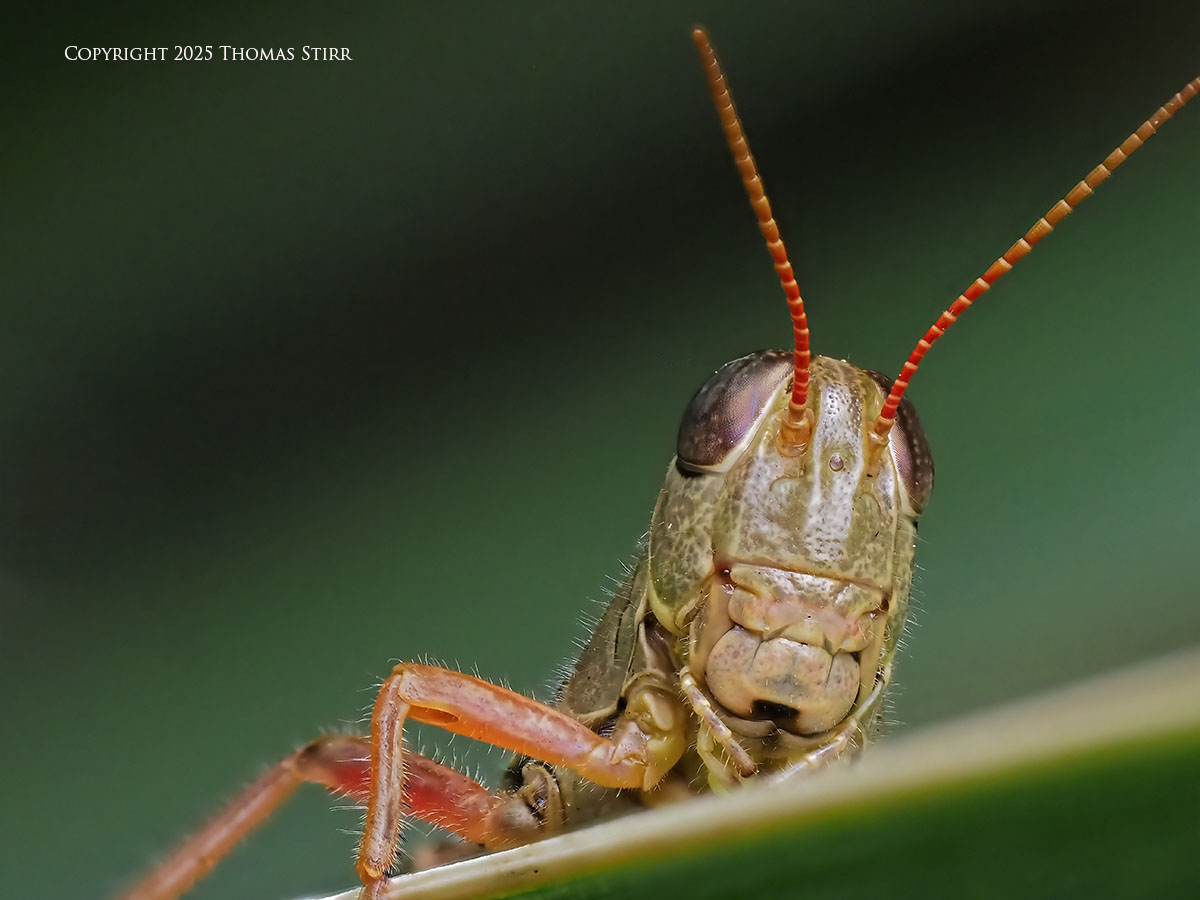
Before I could capture an image, the grasshopper jumped away a second time. After scouring some foliage I found a grasshopper (although I wasn’t sure it was the same one) that was facing my shooting position. It was in a more open area so I was able to slowly move in and create the handheld in-camera focused stacked image above.

One of the things that I’ve always loved about my E-M1X bodies are their dual grip design. This makes it very quick and easy to switch from a landscape to portrait orientation and have all of my essential camera controls in the exact same position. Shortly after capturing this image, the subject grasshopper disappeared.

After exploring some nearby shrubs I located the grasshopper in the above photograph. It’s colouration was completely different which confirmed it was a new subject. As I moved my macro set-up through some stems and branches I was able to capture a few more handheld in-camera focus stacked images of this grasshopper.

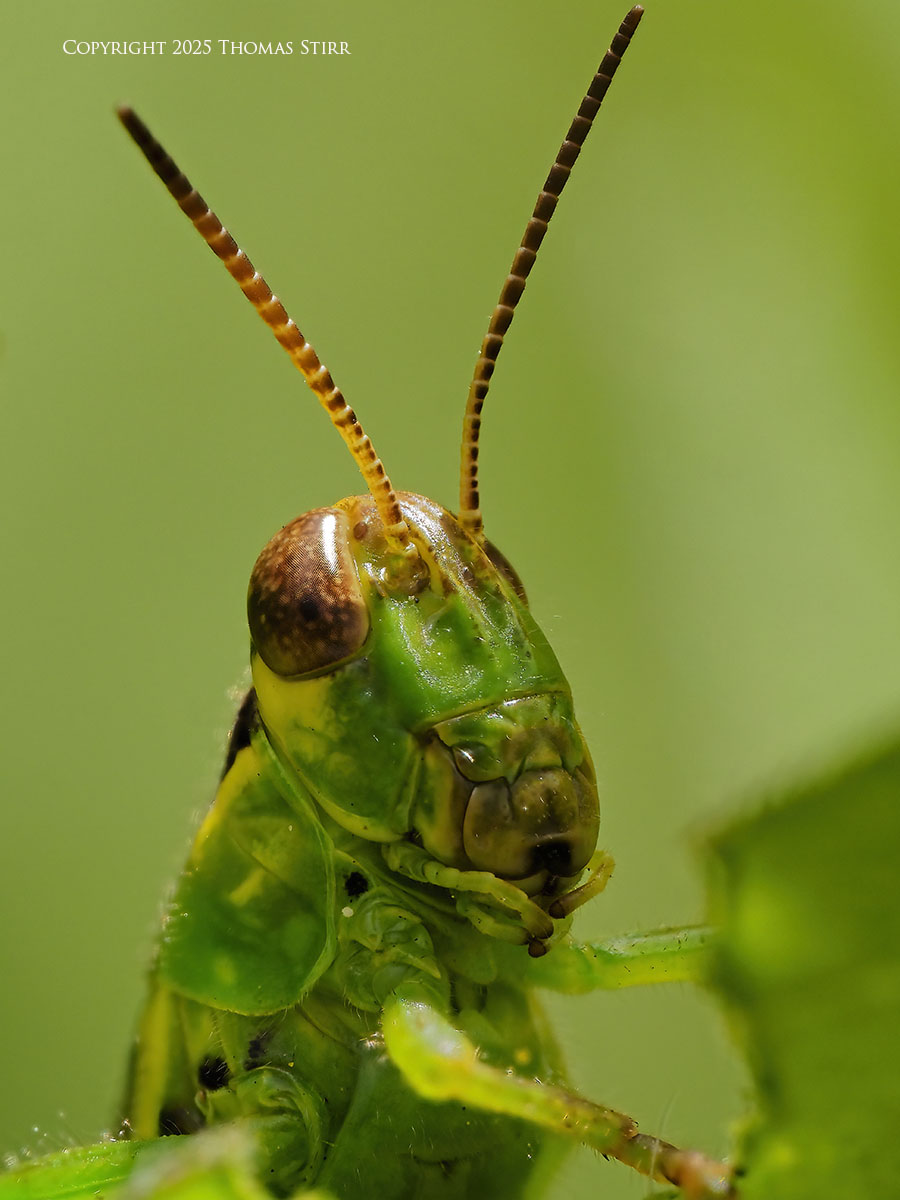

While I was photographing grasshoppers I was able to switch back and forth between my in-camera focus stacking technology, and using my STF-8 Twin Macro Flash.

Since switching to my Olympus/OM System equipment I’ve been doing more macro photography than ever before and enjoying it immensely. I love the creative options that are available to me with computational photography technologies like in-camera focus stacking and Handheld Hi Res.

Having the added flexibility and portability of the M.Zuiko STF-8 Twin Macro Flash readily available provides an additional option.
Capturing a ‘standard’ macro image without the use of any computational photography technology or my STF-8 flash seems a bit strange at times… but it is still a viable option.
When it comes to macro photography the most important thing is to find camera gear that suits our individual shooting styles and preferences. Having the right camera gear for our specific needs allows our creativity to flow.
Technical Note
Photographs were captured handheld using camera gear as noted in the EXIF data. Some photographs were captured using Handheld In-Camera Focus Stacking. A stack of 12 images with a Focus Differential of 4 were used for all of the focus stacked images. All images were created from RAW files or out-of-camera jpegs using my standard process in post. This is the 1,480 article published on this website since its original inception in 2015.
Copyright
Word of mouth is the best form of endorsement. If you like our website please let your friends and associates know about our work. Linking to this site or to specific articles is allowed with proper acknowledgement. Reproducing articles, or any of the images contained in them, on another website or in any social media posting is a Copyright infringement.
Article and images are Copyright 2025 Thomas Stirr. All rights reserved. No use, duplication or adaptation of any kind is allowed without written consent. If you see this article reproduced anywhere else it is an unauthorized and illegal use. Posting comments on offending websites and calling out individuals who steal intellectual property is always appreciated!
I truly enjoy your articles and learn from every one. Re: the OM STF-8 Twin Macro Flash, do you use focus stacking with the STF-8? (I haven’t found any articles on your website. Apologies if I missed it.) Reviews around the web are mixed but frequently not very detailed or contradictory regarding settings and technique. Any advise appreciated.
Hi David,
I don’t use flash very often with my macro photography and typically only do so when trying to photograph a subject, like an insect, that is buried in foliage. The small size of the STF-8 allows me to get the flash inside bushes and shrubs to get my shot. I typically capture a single frame when using flash.
I don’t use the STF-8 with focus stacking as it does not refresh fast enough to do a good job for me when shooting handheld. I suppose I could use the STF-8 with focus stacking if I was using a tripod. As a dedicated handheld photographer this is a non-starter for me.
My preference is to shoot macro in available natural light whenever possible.
Tom