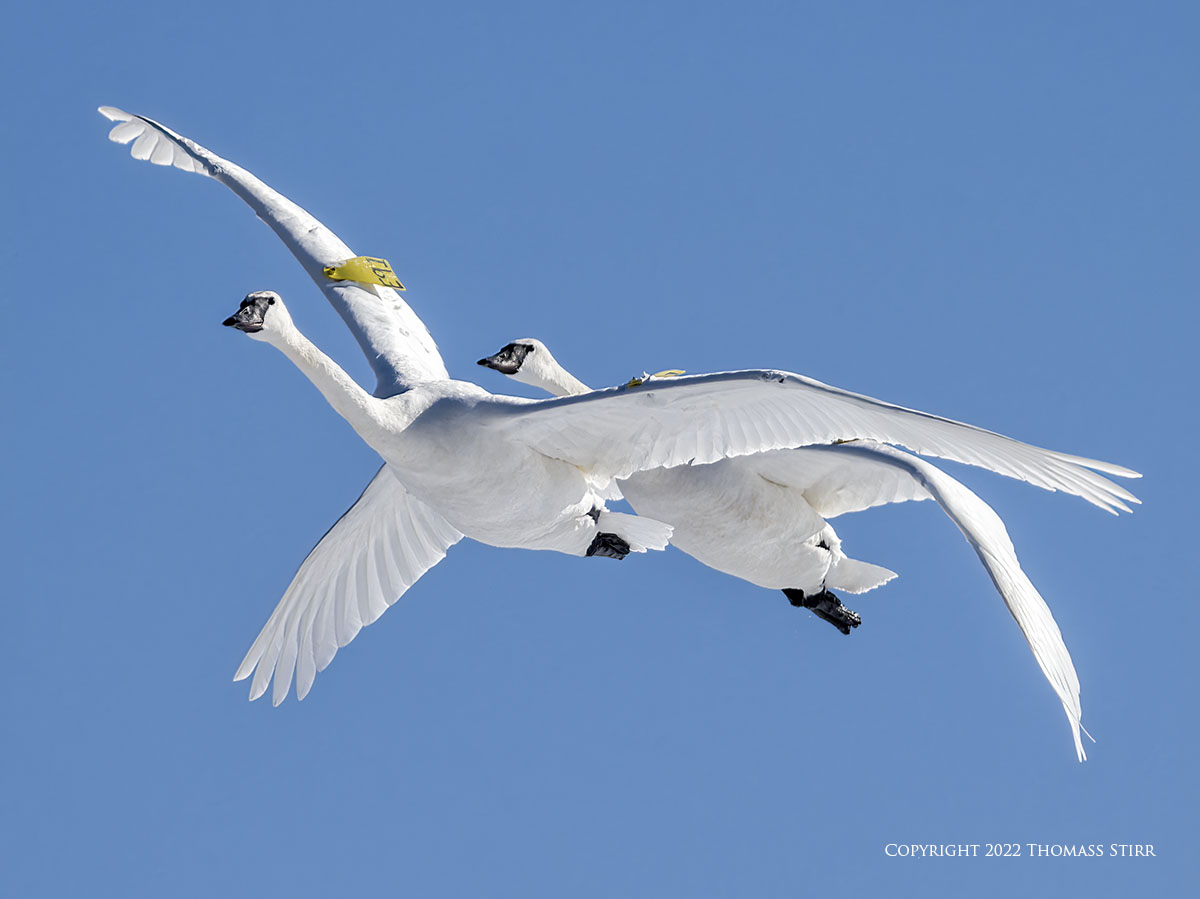
This article discusses some of the considerations that can be used when photographing multiple BIF (birds-in-flight). As photographers each of us has our own objectives and preferred approach to creating images.
When it comes to photographing multiple BIF I prefer capturing a smaller number of birds, and typically photograph groupings of 2 or 3 birds. Everyone is different of course and some folks enjoy creating images of dozens, or even hundreds of birds-in-flight. This isn’t something that I typically do as I like to concentrate on the interactions of a smaller number of birds.
OM-D E-M1X + M.Zuiko 100-400 mm f/5-6.3 IS with M.Zuiko MC-14 teleconverter @ 308 mm, efov 616 mm, f/8.5, 1/2000, ISO-500, Bird Detection AI Subject Tracking, Pro Capture L, cropped to 4700 pixels on the width, subject distance 34.3 metres
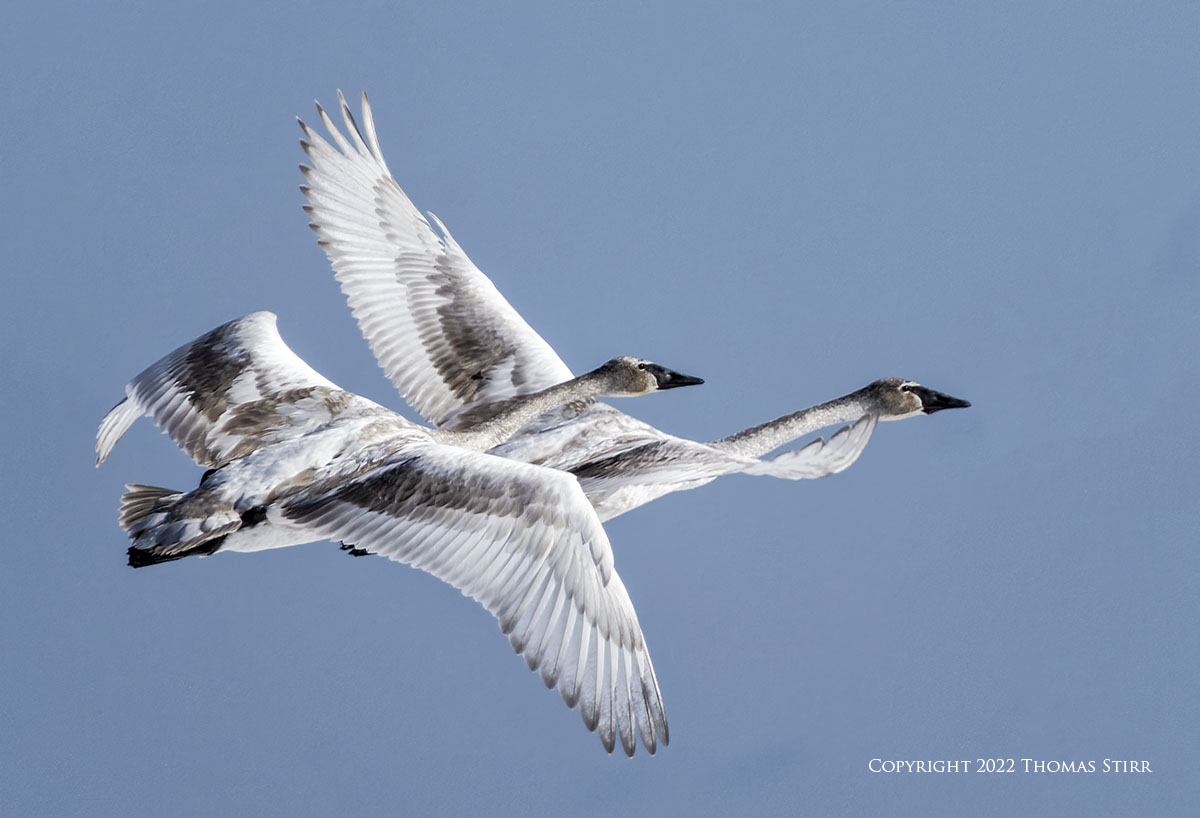
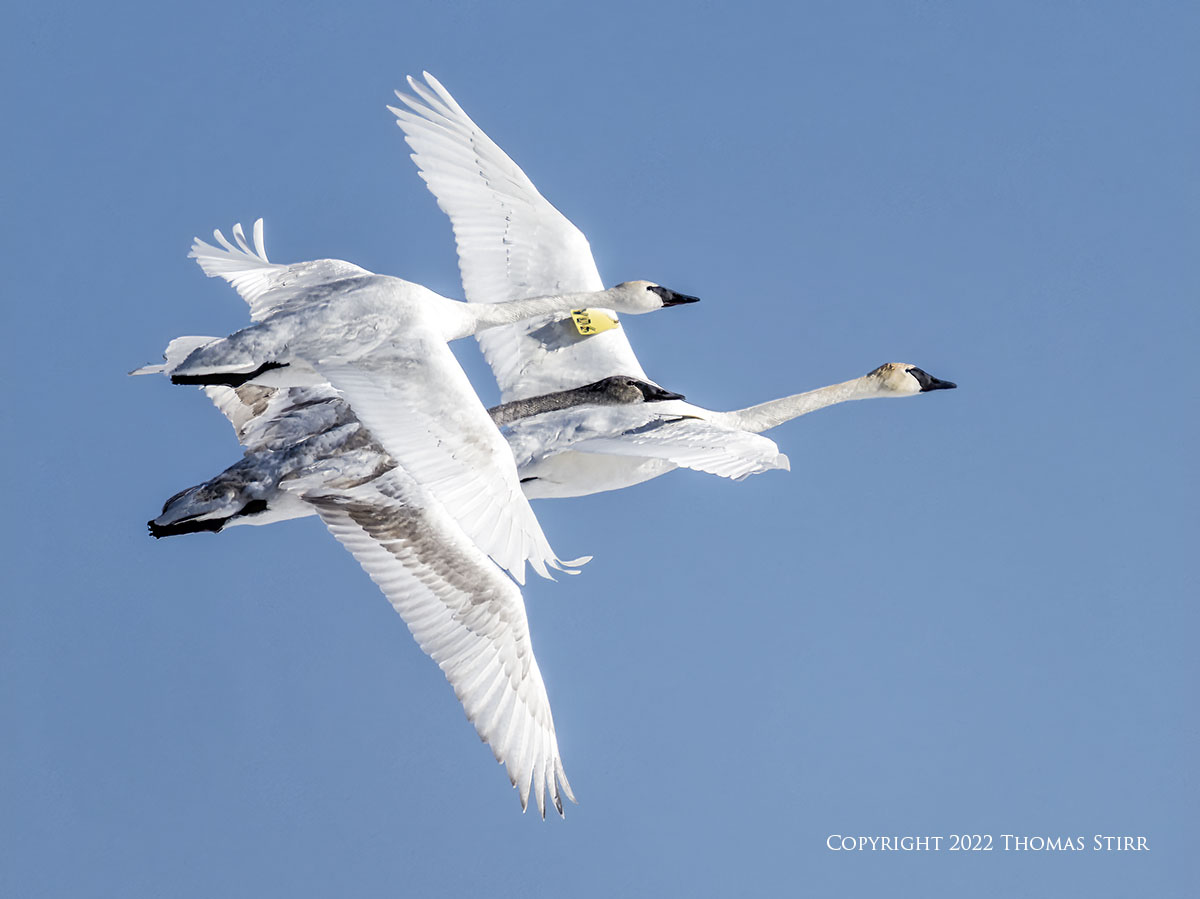
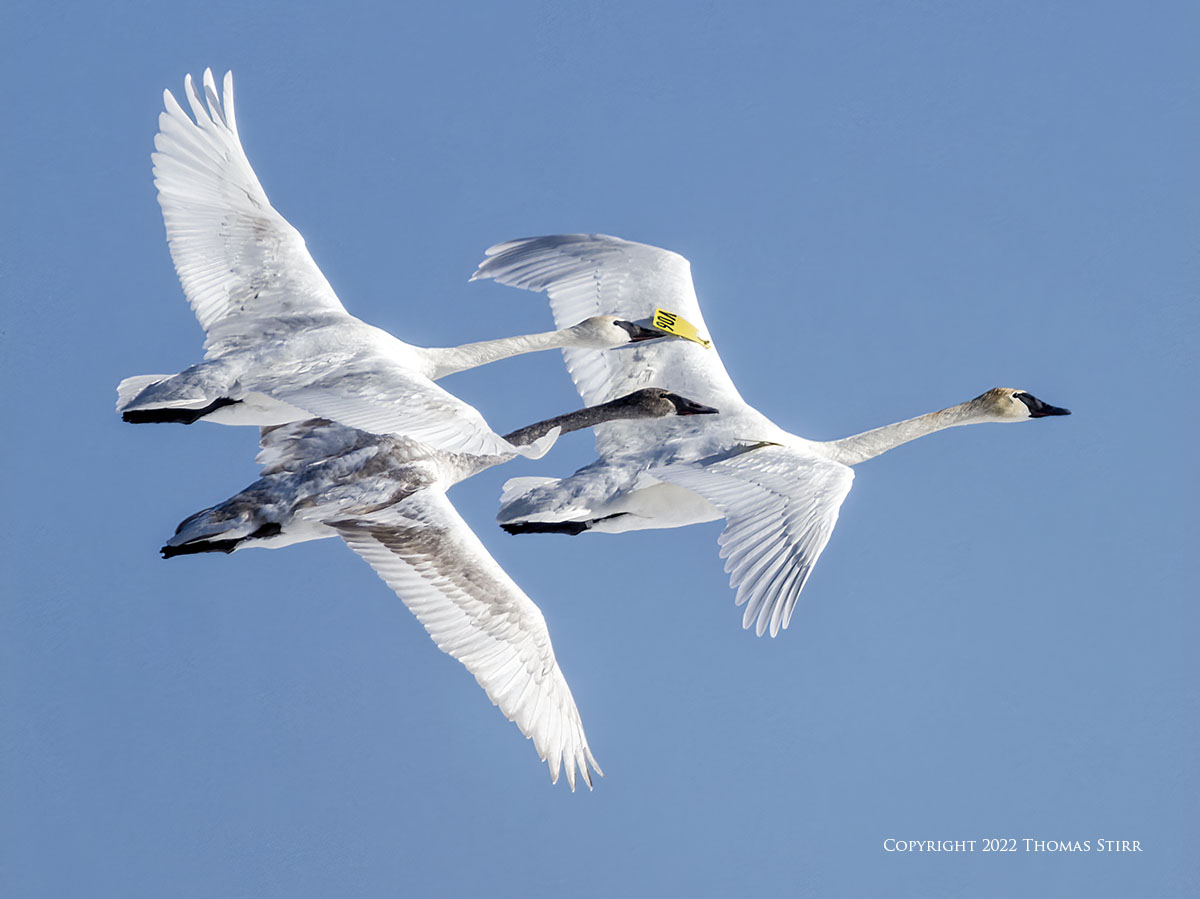
One of the most common opportunities to photograph multiple birds-in-flight is with mated pairs. Waterfowl such as ducks, geese and swans are frequently observed flying as a pair in close proximity.
OM-D E-M1X + M.Zuiko 100-400 mm f/5-6.3 IS with M.Zuiko MC-14 teleconverter @ 308 mm, efov 616 mm, f/8.5, 1/2000, ISO-500, Bird Detection AI Subject Tracking, Pro Capture L, cropped to 2592 pixels on the height, subject distance 35.4 metres
It can sometimes be difficult to get both birds in focus if the pair is flying too far apart in terms of their respective distances from the focal plane of my camera. So, I look for tight flying formations as illustrated with the two images above. I prefer if the birds have their wings fully extended in opposite directions, or with both birds showing downstroke wing positions.
OM-D E-M1X + M.Zuiko 100-400 mm f/5-6.3 IS with M.Zuiko MC-14 teleconverter @ 308 mm, efov 616 mm, f/8.5, 1/2000, ISO-320, Bird Detection AI Subject Tracking, Pro Capture L, cropped to 3789 pixels on the width, subject distance 34.9 metres
On occasion I will shoot up at a grouping of birds, but my preference is to have the birds a bit more distant so the grouping appears to be more at eye level.
OM-D E-M1X + M.Zuiko 100-400 mm f/5-6.3 IS with M.Zuiko MC-14 teleconverter @ 321 mm, efov 642 mm, f/8.6, +0.3 EV, 1/2000, ISO-500, Bird Detection AI Subject Tracking, Pro Capture L, cropped to 4233 pixels on the width, subject distance 62.6 metresOM-D E-M1X + M.Zuiko 100-400 mm f/5-6.3 IS with M.Zuiko MC-14 teleconverter @ 403 mm, efov 806 mm, f/8.8, +0.3 EV, 1/2000, ISO-640, Bird Detection AI Subject Tracking, Pro Capture L, cropped to 3638 pixels on the width, subject distance 89.6 metresOM-D E-M1X + M.Zuiko 100-400 mm f/5-6.3 IS with M.Zuiko MC-14 teleconverter @ 359 mm, efov 718 mm, f/8.7, 1/2000, ISO-400, Bird Detection AI Subject Tracking, Pro Capture L, cropped to 3298 pixels on the width, subject distance 169.4 metre
I try to use shooting angles that help to visually compress the distances between birds.
OM-D E-M1X + M.Zuiko 100-400 mm f/5-6.3 IS with M.Zuiko MC-14 teleconverter @ 346 mm, efov 692 mm, f/8.6, +0.3 EV, 1/2000, ISO-400, Bird Detection AI Subject Tracking, Pro Capture L, cropped to 3539 pixels on the width, subject distance 76.3 metres
I find these types of compositions to be very compelling as they make me wonder how the birds are able to coordinate their wing movements when in such close quarters.
OM-D E-M1X + M.Zuiko 100-400 mm f/5-6.3 IS with M.Zuiko MC-14 teleconverter @ 464 mm, efov 928 mm, f/8.9, +0.3 EV, 1/2000, ISO-500, Bird Detection AI Subject Tracking, Pro Capture L, cropped to 3869 pixels on the width, subject distance 136.9 metres
When photographing multiple BIF many people like the birds to be well separated from each other.
OM-D E-M1X + M.Zuiko 100-400 mm f/5-6.3 IS with M.Zuiko MC-14 teleconverter @ 560 mm, efov 1120 mm, f/9, 1/2000, ISO-500, Bird Detection AI Subject Tracking, Pro Capture L, cropped to 4710 pixels on the width, subject distance 128 metres
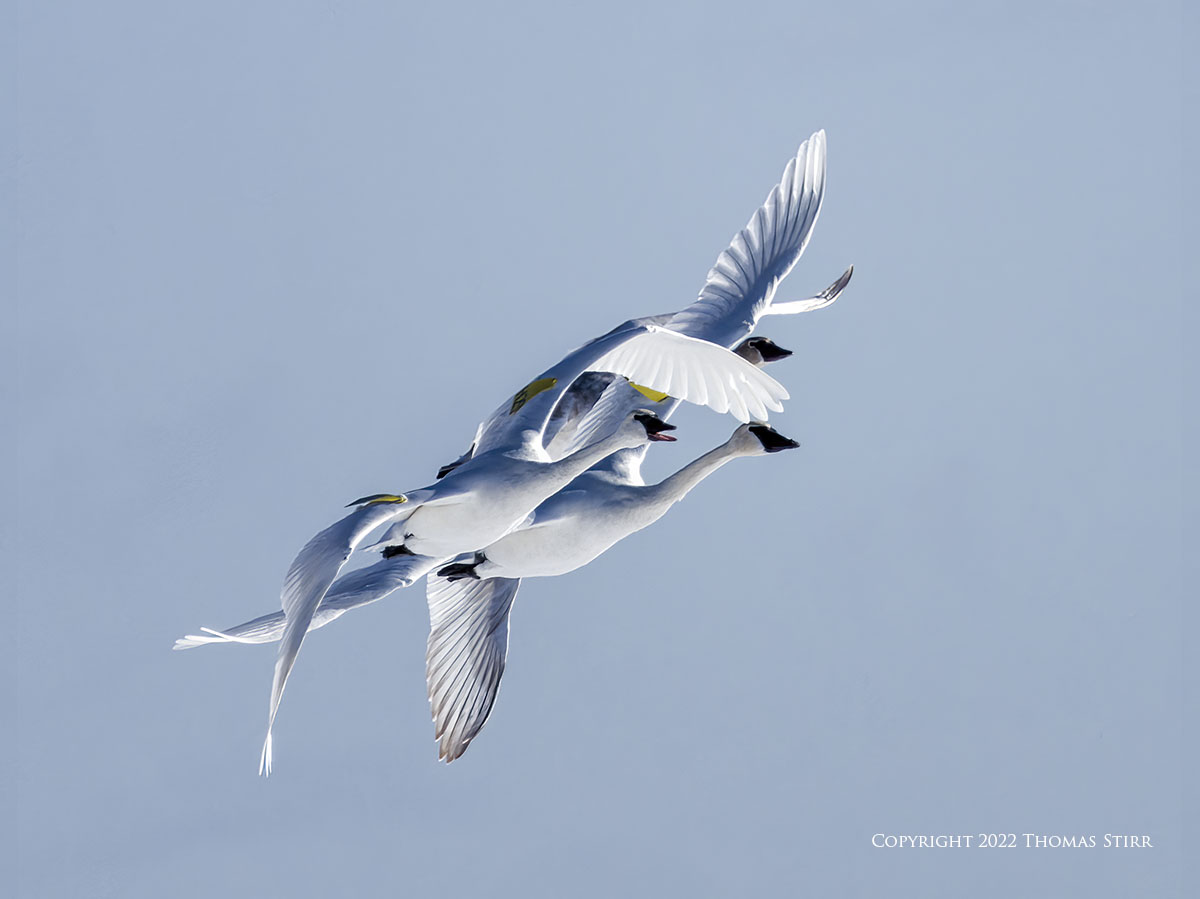
Whenever possible I like to create a 3-D effect when photographing multiple BIF by having the birds visually overlapping on each other.
OM-D E-M1X + M.Zuiko 100-400 mm f/5-6.3 IS with M.Zuiko MC-14 teleconverter @ 560 mm, efov 1120 mm, f/9, 1/2000, ISO-500, Bird Detection AI Subject Tracking, Pro Capture L, cropped to 4206 pixels on the width, subject distance 149.1 metres
I most often look for opportunities when birds are banking, thus making the tops of their wings visible.
OM-D E-M1X + M.Zuiko 100-400 mm f/5-6.3 IS with M.Zuiko MC-14 teleconverter @ 293 mm, efov 586 mm, f/8.5, 1/2000, ISO-250, Bird Detection AI Subject Tracking, Pro Capture L, cropped to 4005 pixels on the width, subject distance 47.3 metres
Shooting up at the bellies of birds is something that I do on occasion, but I normally find the appearance of the topside of wings more pleasing. Unless a bird, or pair of birds, is coming in to land I don’t normally photograph birds that are flying directly into the lens of my camera.
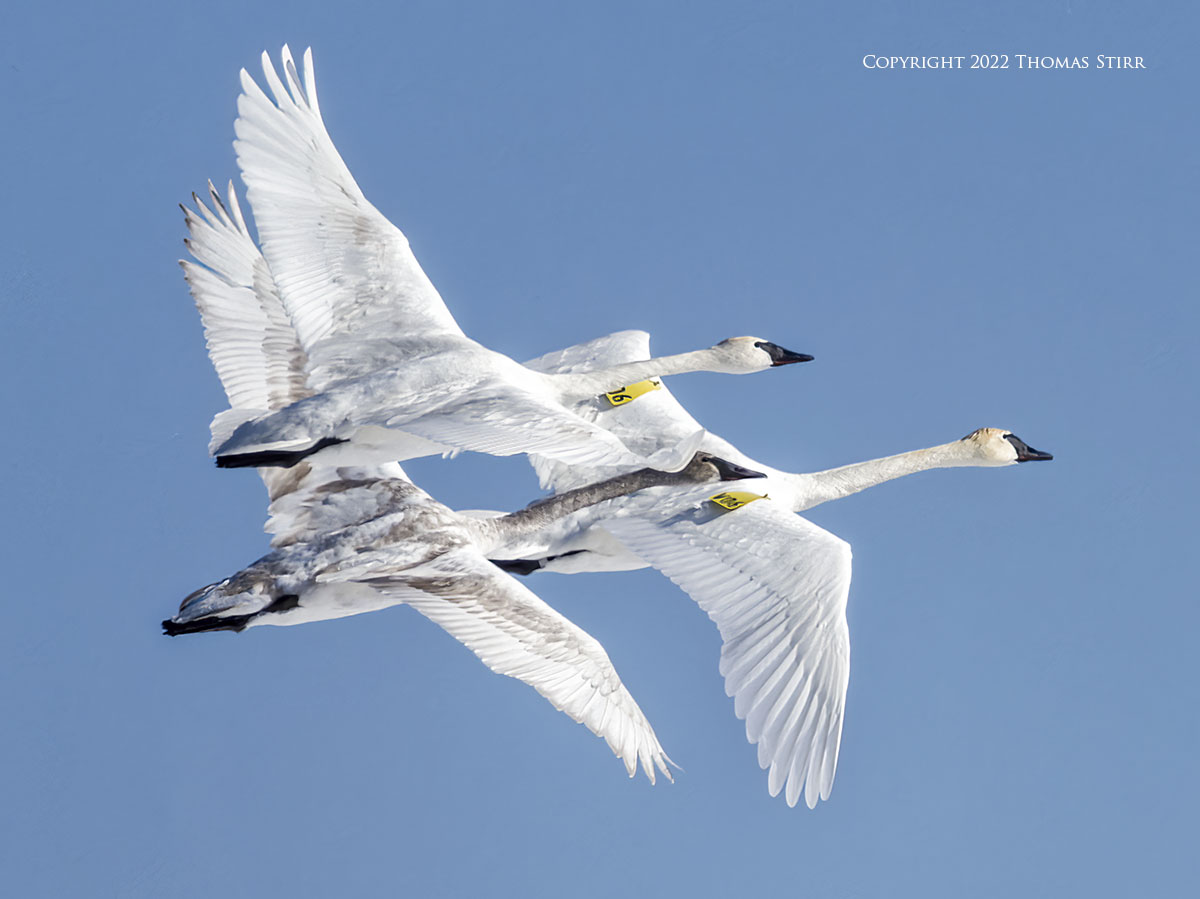
From a geometric standpoint I find groupings of three birds flying together to be the most aesthetically pleasing. When larger groups of birds are flying together I will scan the group to see if I can pick out a trio of birds to photograph.
My two favourite perspectives for a trio of birds are a front-quarter view (as illustrated below) or a profile view. As noted earlier, I usually wait for the birds to be in very tight to each other as I find this adds some drama to the images.
The next four photographs are from the same image run. You can see that as image run progressed the birds drew further away from each other. To my eye, the most drama is created with the first two images.
OM-D E-M1X + M.Zuiko 100-400 mm f/5-6.3 IS with M.Zuiko MC-14 teleconverter @ 560 mm, efov 1120 mm, f/9, +0.3 EV, 1/2000, ISO-800, Bird Detection AI Subject Tracking, Pro Capture L, cropped to 3378 pixels on the width, subject distance 263 metresOM-D E-M1X + M.Zuiko 100-400 mm f/5-6.3 IS with M.Zuiko MC-14 teleconverter @ 560 mm, efov 1120 mm, f/9, +0.3 EV, 1/2000, ISO-800, Bird Detection AI Subject Tracking, Pro Capture L, cropped to 3305 pixels on the width, subject distance 263 metresOM-D E-M1X + M.Zuiko 100-400 mm f/5-6.3 IS with M.Zuiko MC-14 teleconverter @ 560 mm, efov 1120 mm, f/9, +0.3 EV, 1/2000, ISO-800, Bird Detection AI Subject Tracking, Pro Capture L, cropped to 3629 pixels on the width, subject distance 250.2 metresOM-D E-M1X + M.Zuiko 100-400 mm f/5-6.3 IS with M.Zuiko MC-14 teleconverter @ 560 mm, efov 1120 mm, f/9, +0.3 EV, 1/2000, ISO-800, Bird Detection AI Subject Tracking, Pro Capture L, cropped to 3948 pixels on the width, subject distance 235.2 metres
When photographing multiple BIF I concentrate on the geometric shape that a grouping of birds is creating, rather than seeing the birds as individuals. Groupings of three birds typically has a lead bird with two others following. This usually creates a natural triangular shape which provides balance to a composition.
Our final five photographs are from the same image run and illustrate the natural ‘flying triangle’ of a three bird formation.
OM-D E-M1X + M.Zuiko 100-400 mm f/5-6.3 IS with M.Zuiko MC-14 teleconverter @ 560 mm, efov 1120 mm, f/9, +0.3 EV, 1/2000, ISO-500, Bird Detection AI Subject Tracking, Pro Capture L, cropped to 3544 pixels on the width, subject distance 209.5 metresOM-D E-M1X + M.Zuiko 100-400 mm f/5-6.3 IS with M.Zuiko MC-14 teleconverter @ 560 mm, efov 1120 mm, f/9, +0.3 EV, 1/2000, ISO-500, Bird Detection AI Subject Tracking, Pro Capture L, cropped to 3279 pixels on the width, subject distance 211.6 metresOM-D E-M1X + M.Zuiko 100-400 mm f/5-6.3 IS with M.Zuiko MC-14 teleconverter @ 560 mm, efov 1120 mm, f/9, +0.3 EV, 1/2000, ISO-500, Bird Detection AI Subject Tracking, Pro Capture L, cropped to 3694 pixels on the width, subject distance 190.3 metresOM-D E-M1X + M.Zuiko 100-400 mm f/5-6.3 IS with M.Zuiko MC-14 teleconverter @ 560 mm, efov 1120 mm, f/9, +0.3 EV, 1/2000, ISO-500, Bird Detection AI Subject Tracking, Pro Capture L, cropped to 3587 pixels on the width, subject distance 213.8 metresOM-D E-M1X + M.Zuiko 100-400 mm f/5-6.3 IS with M.Zuiko MC-14 teleconverter @ 560 mm, efov 1120 mm, f/9, +0.3 EV, 1/2000, ISO-500, Bird Detection AI Subject Tracking, Pro Capture L, cropped to 3994 pixels on the width, subject distance 224.4 metres
When photographing multiple BIF I try to position myself so that the majority of approaching birds are flying at an angle towards the sun.
Technical Note:
Photographs were captured handheld using camera gear as noted in the EXIF data. Images were produced from RAW files using my standard process. All images are displayed as full frame captures without any cropping. Photographs were resized for web use. This is the 1,129 article published on this website since its original inception in 2015.
Copyright
Article and images are Copyright 2022 Thomas Stirr. All rights reserved. No use, duplication or adaptation of any kind is allowed without written consent. If you see this article reproduced anywhere else it is an unauthorized and illegal use. Posting comments on offending websites and calling out individuals who steal intellectual property is always appreciated!
This website celebrates the joy of photography and features a wide range of photographic subject matter. The content is designed to appeal to a wide range of people interested in photography. The website also provides information to help readers increase their level of photographic freedom.
You cannot copy content of this page
We use cookies to ensure that we give you the best experience on our website. This is an advertising free website and we do not use any kind of advertising tracking cookies. Your email address or any other information you provide as your subscription to the website is never sold to any other party. If you subscribe to this website your email address is used to send out notifications on new articles. If you continue to use this site we will assume that you are happy with our approach to cookie use.