
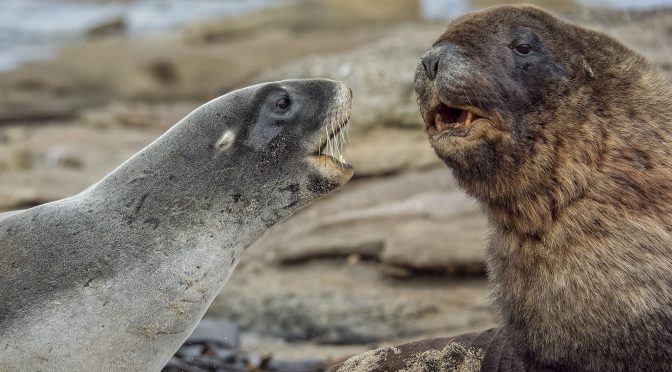
Sometimes an impromptu exploration can lead to an unexpected reward. Such was the case when my wife suggested that we leave the main coastal road to photograph a small lighthouse along the southern coast of the South Island in New Zealand. What we discovered were some sea lions at Waipapa Point, giving us the opportunity to get up close and personal!
NOTE: Click on images to enlarge.
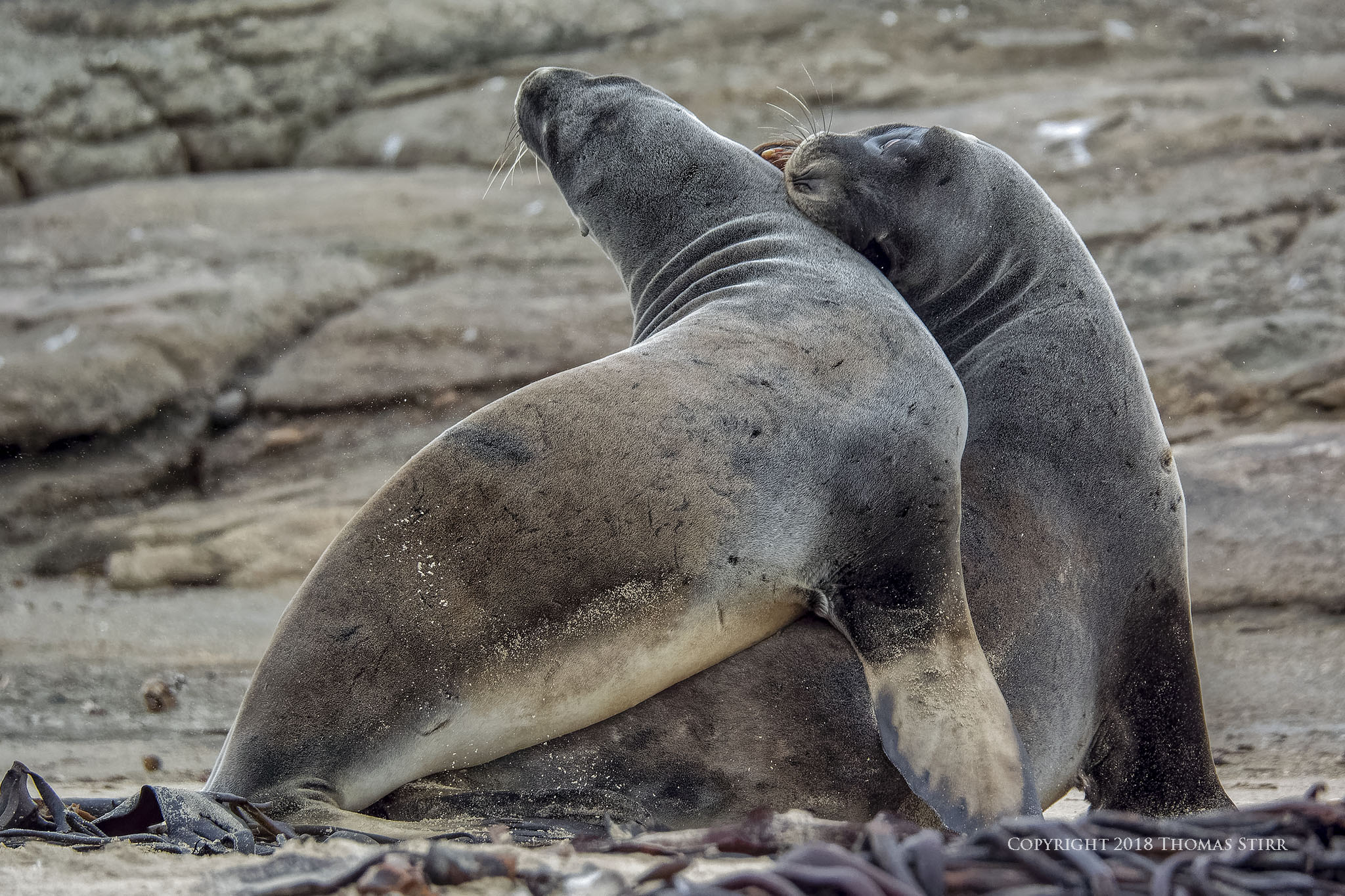
When we first arrived we spotted two female sea lions engaged in a bit of a tussle with their heads weaving, sand flying and some biting going on. We didn’t notice any blood being drawn, so we assumed that the altercation wasn’t too serious.
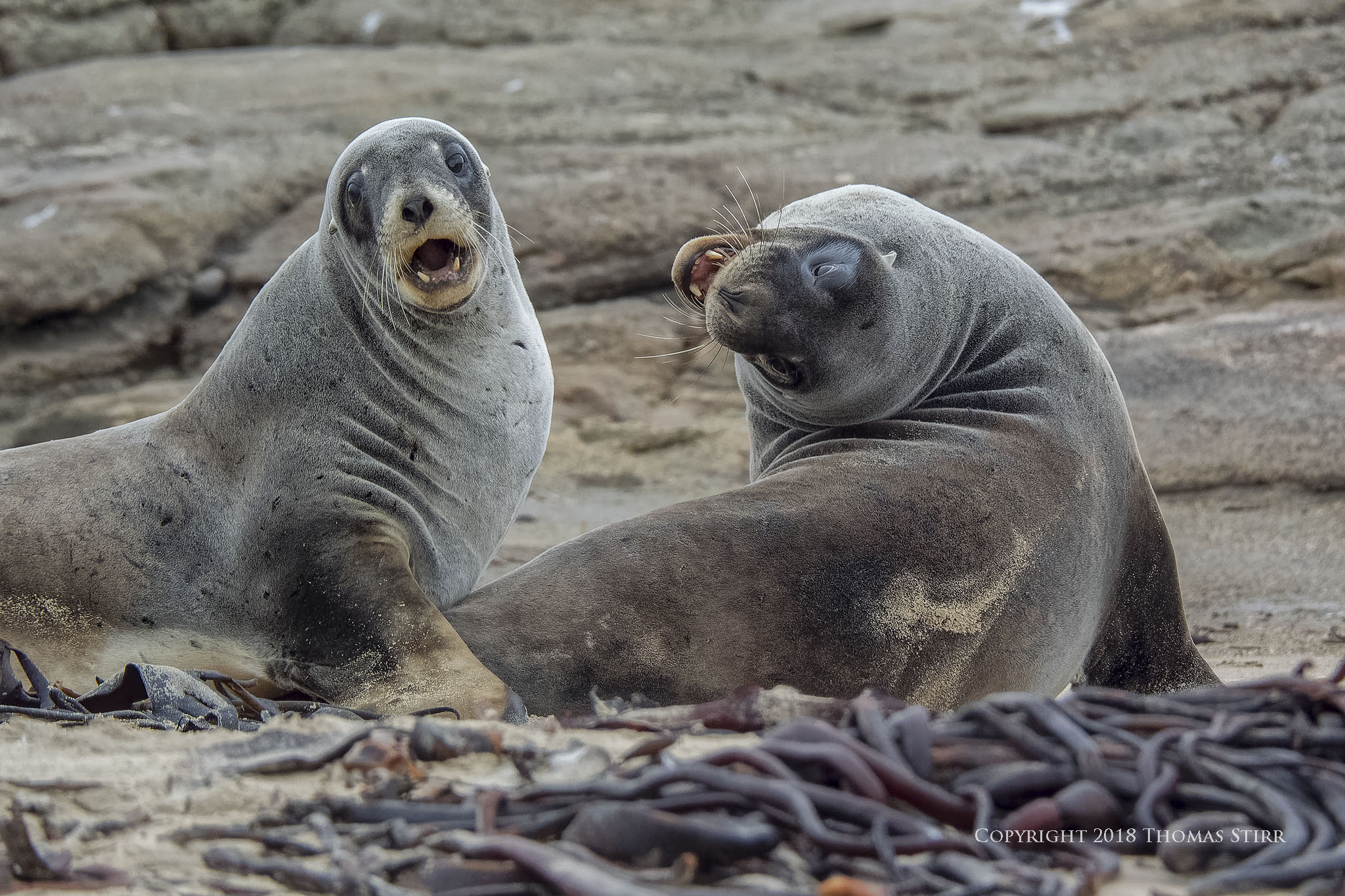
New Zealand sea lions are thought to be the world’s rarest sea lion species with an estimated population of about 10,000 to 12,000. They are also considered to be the most threatened sea lion in the world. We were extremely fortunate to have the opportunity to see and photograph them as very few individuals frequent the southern coast of the South Island. Most of the population is around the Auckland and Campbell sub Antarctic islands.

There was also a large male sea lion on the beach. He was an older, lumbering brute that could have weighed as much as 450 kilos (~1,000 lbs.). He ambled over to the two squabbling females and they settled down to some degree in his presence. The females appeared to be about half his size, perhaps a bit less.

There is a warning sign at the Waipapa Point Lighthouse recommending that people stay at least 10 metres (~33 feet) away from the sea lions. While large and appearing ungainly, they can move fairly quickly for short distances.

Their jaws are large, powerful and well equipped with teeth, including large canines. As I moved in to capture my images, my wife kept careful watch from a distance just in case any of the sea lions took issue with my presence so she could warn me.

If you enlarge the image above and look carefully in the sea lion’s eye you will be able to see my reflection. The 1 Nikon CX 70-300mm f/4.5-5.6 zoom was a terrific lens to use for this subject matter. Fully extended it gave me an equivalent field-of-view of 810mm – giving plenty of reach to photograph the sea lions.

New Zealand sea lions feed on fish (hoki and red cod), cephalopods like New Zealand arrow squid and yellow octopus, crustaceans, birds and other marine mammals. In turn, New Zealand sea lions are predated on by great white sharks.
Our impromptu visit to Waipapa Point was certainly a memorable one. If you ever visit the South Island of New Zealand, taking a drive out to this area could be a special experience should you be lucky enough to see these endangered animals!
Technical Note:
All photographs were captured hand-held using Nikon 1 gear as per the EXIF data. All images were produced from RAW files using my standard process of DxO PhotoLab, CS6 and the Nik Collection.
Article and images are Copyright 2018 Thomas Stirr. All rights reserved. No use, duplication or adaptation of any kind is allowed without written consent. If you see this article reproduced anywhere else it is an unauthorized and illegal use. Posting comments on offending web sites and calling out individuals who steal intellectual property is always appreciated!
I did see you in the sea lion’s eye. Thanks for sharing. I had never seen a picture of a male sea lion. Wow. Very enjoyable.
I’m glad you enjoyed the photographs Pam! We were incredibly fortunate to have seen these sea lions in the wild given that they are so rare. Getting some usable images was a huge bonus.
Tom
Really nice pictures Tom.
Thanks Anders – glad you enjoyed them!
Tom